What Stromboli is
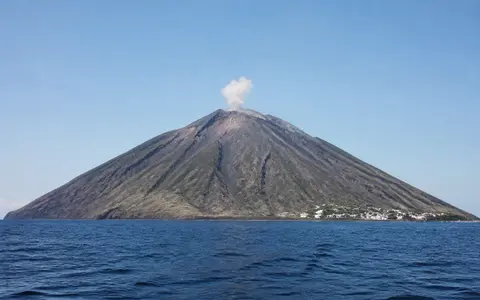
Stromboli is both an island and the emerged summit of a much larger volcanic edifice. Only about 12 square kilometres of the cone stand above the Tyrrhenian Sea; below the coast, its flanks continue down for roughly 2,000 metres to the surrounding seafloor. The result is an ocean-bounded mountain with far greater total relief than its above-water height suggests.
The island has an approximately conical outline elongated from southwest to northeast. Its summit zone is not a single pointed peak: the highest ridge rises above an active crater terrace on the upper northwestern flank. Repeated eruptions, erosion, and sector collapses have made the cone asymmetric, most visibly where the Sciara del Fuoco cuts through the northwest side.
At the end of the Aeolian chain
Stromboli is the northeasternmost emerged volcano of the Aeolian arc. It lies between the main Aeolian island group to the southwest and the Calabrian coast to the east, with open Tyrrhenian water on every side. The coast is only a few kilometres across, so the volcano's upper slopes, coastal foot, and submarine continuation form one compact landform system.
About 2 kilometres northeast of the main island, Strombolicchio rises as a resistant volcanic remnant. It marks an older volcanic center along the same northeast–southwest trend as Stromboli. Together, the island, the offshore rock, and the submerged ridges and aprons show that the visible cone is only the latest and most prominent part of a longer-lived volcanic landscape.
Crater terrace, summit ridge, and collapse flank
The active vents occupy a crater terrace at roughly 700 to 750 metres elevation, below the highest ground. Vent positions and small craters change as explosions redistribute scoria, bombs, and ash. This terrace arrangement distinguishes the active center from the older summit ridge above it and directs much loose eruptive material toward the northwest.
The Sciara del Fuoco is a steep, horseshoe-shaped collapse depression that runs from the crater area to the sea and continues far down the submarine flank. Lava flows, rolling blocks, and pyroclastic debris commonly use this open slope as a direct route toward the coast. Outside the Sciara, older crater remnants, collapse scarps, and overlapping lava-and-tephra units preserve successive stages in the growth and partial failure of the cone.
Crater terrace
Multiple vents occupy a shelf below the island's highest ridge.
Sciara del Fuoco
A collapse-bounded chute links the active vents directly to the sea.
Submarine cone
Steep slopes and sediment aprons continue far below sea level.
A cone built and reworked on steep slopes
Successive lava flows provide resistant ribs and ledges, while beds of ash, lapilli, scoria, and other loose volcanic fragments form less stable surfaces between them. Near the active area, fresh deposits can cover older ground quickly. Farther downslope, weathering and runoff cut shallow channels into fragmental material, and sea cliffs expose stacked volcanic units around much of the coast.
Gravity is a major link between the summit and the submarine landscape. Rockfalls, debris avalanches, lava, and pyroclastic material descend the steep flanks, especially within the Sciara del Fuoco, and accumulate along the shoreline or continue underwater. Wave erosion removes material from exposed coastal sectors, while narrow shelves on parts of the northeast, southeast, and southwest interrupt the otherwise steep descent to deep water.
Seasonal rain on a porous maritime cone
Stromboli has a semi-arid Mediterranean island climate shaped by the surrounding sea. Summers are generally warm and dry, while most rain falls in autumn and winter. Elevation cools the upper slopes and exposure to wind changes conditions around the cone, but the island is too small to develop broad interior climate zones.
There are no long permanent rivers. Rain runs downslope through short gullies and can produce rapid local floods when intense storms fall on steep, ash-covered terrain. Elsewhere, water infiltrates fractured lava and porous deposits toward a small coastal groundwater system. Runoff and groundwater paths vary because permeable layers alternate with denser lava, altered rock, and fine pyroclastic beds.
Volcanism between Sicily and Calabria
Stromboli occupies the northeastern end of the Aeolian volcanic arc, a chain of islands and submarine volcanoes related to the complex plate boundary beneath the southern Tyrrhenian region. Its position links the emerged Aeolian Islands to surrounding seamounts, deep marine basins, and the tectonically active margins of Sicily and Calabria.
The volcano gave its name to Strombolian activity: discrete, repeated explosions that eject incandescent fragments from an open vent. In geographic terms, that activity continually alters the crater terrace and supplies material to the Sciara del Fuoco, tying eruptive process to landform change. Within Geography Atlas, Stromboli belongs with the volcanoes hub and mountains hub; its island-cone setting also complements nearby Mediterranean records for Mount Etna and Santorini Caldera.