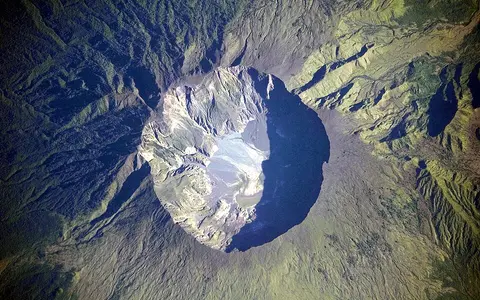

What Mount Tambora is
Mount Tambora rises on the north side of Sumbawa in the Lesser Sunda Islands of Indonesia. The volcanic edifice forms the Sanggar Peninsula, projecting into waters between Sumbawa and the Flores Sea.
The record belongs in the volcano archive because Tambora is not just a named summit. Its physical geography includes a composite volcano, a large summit caldera, old lava and pyroclastic surfaces, radial drainage lines, coastal slopes, and island-arc structure tied to subduction along the Sunda margin.
Caldera, rim relief, and volcanic peninsula
Tambora's most legible landform is the high caldera at the summit. Steep inner walls descend into the collapse basin, while the outer slopes spread across the peninsula toward coastal lowlands.
The modern form records both construction and removal. Lava flows and fragmental volcanic deposits built the older mountain, then explosive eruption and collapse opened the summit basin. Later minor domes and flows on the caldera floor show that activity continued after the main collapse-forming episode.
Caldera basin
Collapse created a deep, enclosed volcanic depression with steep walls and a rugged floor.
Radial slopes
Ridges and ravines descend outward from the high cone toward the peninsula margins.
Sea-reaching deposits
Pyroclastic flows and ash connected the eruption terrain to surrounding shorelines.
Seasonal runoff across ash-rich terrain
Tambora's drainage is controlled by cone geometry and monsoon seasonality. Wet-season rain runs down steep radial channels, while dry-season conditions expose loose ash, pumice, and weathered volcanic surfaces on parts of the slopes.
Where channels cut into unconsolidated tephra and pyroclastic material, runoff can move sediment efficiently from upper slopes toward lower valleys and coastal plains. This gives the volcano a larger geographic footprint than the caldera alone, because water and sediment link summit relief, flank ravines, and peninsula margins.
Sumbawa and the Sunda volcanic arc
Tambora belongs to the Sunda Arc, where subduction-related volcanism forms a chain of islands and volcanic centers across Indonesia. On Sumbawa, the volcano sits within a region of rugged relief, narrow coastal lowlands, and adjacent marine basins.
Compared with cone-focused records such as Mount Fuji, Tambora is especially useful for reading caldera collapse and peninsula-scale deposits. Compared with island-caldera records such as Krakatoa and Santorini Caldera, Tambora keeps the main caldera on a large island edifice rather than inside a flooded strait or marine basin.