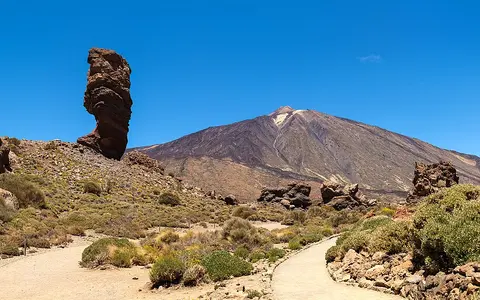

What Teide is
Teide is the eastern and higher summit of the Teide–Pico Viejo volcanic complex. The complex grew after formation of the Las Cañadas depression and now fills much of its northern sector. Although Teide is often described as a single cone, its physical setting includes Pico Viejo to the west-southwest, Montaña Blanca to the east, peripheral lava domes, and younger vents and flows spread across the surrounding high ground.
The mountain is part of Tenerife's much larger volcanic structure, which continues below sea level to the ocean floor. At the scale visible on land, Teide is a steep central edifice surrounded by lava fields and enclosed on the south and east by the arc of the Las Cañadas wall.
Atlantic island and caldera position
Teide stands near the center of Tenerife, the largest of the Canary Islands, west of the African mainland in the eastern North Atlantic. Its inland summit position separates it from volcanoes built directly along a shoreline: the cone rises above an island plateau, while long outer slopes descend toward deeply cut valleys and the coast.
Las Cañadas is an incomplete, elongated depression about 10 by 17 kilometres across. Its floor lies near 2,100 metres above sea level, and the preserved caldera wall forms a prominent amphitheatre around the southern side. The northern margin is obscured or absent, and younger products from Teide and Pico Viejo cover parts of the older structure.
Summit cone, twin edifice, and lava aprons
Teide's upper cone culminates in a small summit crater. Below it, overlapping lava flows and fragmental deposits form steep radial slopes. Dark, relatively young flows cross older, paler surfaces and locally preserve channels, levees, pressure ridges, and rough blocky fronts. These contrasts make the sequence of landform construction visible across the high plateau.
Pico Viejo is a broad companion stratovolcano joined to Teide by a high saddle. Its much wider summit crater and western lava fields give the combined edifice an asymmetric profile. Around both cones, domes, scoria cones, and fissure vents show that volcanic growth has occurred from numerous outlets rather than from the main summit alone.
Central cone
A small crater caps Teide above steep, layered volcanic slopes.
Pico Viejo
A second stratovolcano broadens the complex and contains a large crater.
Post-caldera terrain
Lava flows, domes, and cones partly fill the older Las Cañadas depression.
Constructive volcanism over an older landscape
The present relief records alternating construction and destruction. Older volcanic edifices built Tenerife's central highland; explosive eruptions, collapse, and large slope failures helped create the Las Cañadas depression and major valleys on the island's flanks. Later eruptions raised the Teide–Pico Viejo complex within that lowered central surface.
Lavas range from relatively fluid mafic flows to more viscous, silica-rich trachytic and phonolitic material. Loose pumice, ash, and scoria lie beside welded or massive lava surfaces. Erosion acts slowly on the driest high ground, but exposed older formations along the caldera wall and Roques de García have been cut into ridges, cliffs, and resistant rock pinnacles.
Trade winds, inversion, and porous slopes
Tenerife lies within the belt of northeast trade winds. Moist maritime air commonly produces cloud on the windward middle slopes, but Teide's summit and the Las Cañadas floor often stand above the main cloud layer. The high interior is therefore cool, dry, sunny, and exposed, with strong day-to-night temperature changes. Winter snow can cover the upper cone temporarily, but no permanent glacier occupies the summit.
Surface drainage is limited because fractured lava and loose volcanic deposits absorb much of the rainfall and snowmelt. Short gullies and channels carry episodic runoff across the caldera floor or down the outer slopes during wet periods, while a substantial share of water percolates into the island's volcanic aquifers. Teide also helps divide drainage toward Tenerife's northern and southern flanks.
Rift zones and the wider Tenerife massif
Teide occupies the meeting area of Tenerife's principal volcano-structural trends. The northeast ridge and the northwest rift zone connect the central complex to chains of vents and elongated high ground elsewhere on the island. Historical eruptions have occurred on these flanks and near Pico Viejo, so the geographic volcano system extends beyond Teide's summit crater.
Within Geography Atlas, Teide is best read through the volcanoes hub and the mountains hub. Its ocean-island setting also provides a useful contrast with the broad shield form of Mauna Loa and the flooded island-ring relief of Santorini Caldera.