.jpg)
What Mount Pinatubo is
Mount Pinatubo rises near the meeting area of Zambales, Tarlac, and Pampanga on the island of Luzon. It is part of a volcanic highland belt west of the Central Luzon plain and east of coastal terrain facing the South China Sea.
The record belongs in the volcano archive because Pinatubo is not only a cone. Its present geography is a connected system of caldera walls, crater-lake water, ash and pumice deposits, pyroclastic-flow surfaces, and valleys filled or reworked by volcanic sediment.
Caldera, crater lake, and broken summit relief
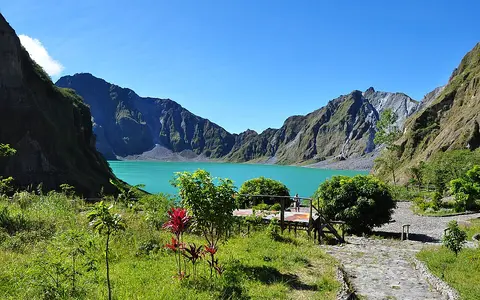
The climactic 1991 eruption removed enough material from beneath the summit for the upper volcano to collapse into a caldera. Steep inner walls now frame Lake Pinatubo, while the surrounding high ground preserves parts of the older volcanic edifice.
This landform is best read from the inside outward: a lake-filled collapse basin at the summit, unstable crater walls around it, then broad aprons of pyroclastic and lahar deposits that extend into lower valleys.
Lake-filled caldera
The central basin records collapse after magma and rock were evacuated during the eruption.
Ash-rich slopes
Loose tephra and pyroclastic material mantle parts of the volcano and feed sediment downstream.
Lahar fans and channels
Debris-rich flows follow river valleys toward the Central Luzon plain and western drainage basins.
Radial valleys and sediment movement
Pinatubo's hydrology is controlled by steep volcanic slopes, heavy rainfall, and abundant loose sediment. Streams draining the edifice can cut into ash and pyroclastic-flow deposits, turning rainfall into muddy, debris-laden flows.
The main geographic effect is downstream connectivity. Material that begins on the cone can move through river corridors, aggrade valley floors, alter channels, and spread onto alluvial fans and lowland plains. This makes Pinatubo a strong example of a volcano whose physical footprint extends well beyond the summit.
Western Luzon volcanic terrain
The volcano sits in western Luzon, where volcanic highlands interrupt the transition between the Central Luzon lowlands and the Zambales-side coastal region. Its location links mountain relief, volcanic-arc structure, and tropical watershed behavior.
Compared with cone-focused records such as Mount Fuji, Pinatubo is especially useful for reading collapse and post-eruption sediment movement. Compared with caldera records such as Santorini Caldera, it keeps the caldera-lake and lahar system on land rather than in a flooded marine setting.