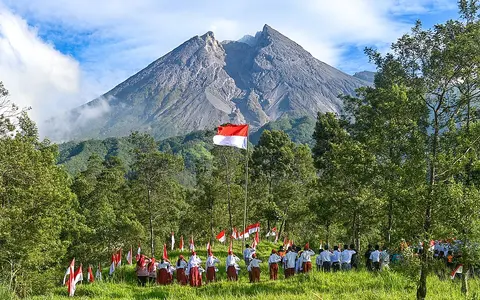

What Mount Merapi is
Mount Merapi rises in south-central Java, just north of the Yogyakarta lowland and south of the older Mount Merbabu massif. It is part of the Sunda Volcanic Arc, the long chain of Indonesian volcanoes related to subduction along the southern margin of Java and nearby islands.
In physical geography terms, Merapi is best read as a compact, high-relief stratovolcano. Its steep upper cone, active summit dome area, radial ravines, aprons of ash and blocky volcanic debris, and short drainage systems make the landform more than a single peak on a map.
Summit dome, cone slopes, and ravine relief
Merapi's summit region is shaped by repeated lava-dome growth and partial collapse. Viscous lava can pile up near the crater, forming steep-sided domes that alter the summit profile and feed unstable blocky material onto the upper flanks.
Below the summit, slopes descend quickly into narrow valleys. These ravines are important terrain features because they guide hot avalanches, pyroclastic-flow deposits, normal runoff, and wet-season sediment pulses. The cone therefore has a strongly radial organization: summit material moves outward through a set of steep channels rather than across a broad open plateau.
Lava-dome complex
Active dome growth and collapse reshape the crater area and supply loose blocky debris.
Steep radial valleys
Short ravines cut the cone and direct flows toward western, southern, and southeastern lowlands.
Ash and block-and-ash surfaces
Fragmental volcanic material mantles slopes and can be remobilized by rainfall.
Monsoon runoff and lahar pathways
Java's tropical monsoon climate gives Merapi a strong wet-season control. Heavy rain can fall on fresh ash, loose dome-collapse debris, and older pyroclastic deposits, turning dry volcanic sediment into channelized lahars and muddy flood pulses.
Named drainages on the western and southwestern flanks, including the Krasak, Sat/Putih, Bebeng, and related valleys, show how the volcano's relief and sediment supply are tied together. South-flank systems such as the Boyong and Gendol also carry the imprint of summit-fed material. Even when eruptive activity is concentrated high on the cone, water and gravity extend its geomorphic effects into lower valley floors.
Equatorial heat, seasonal rainfall, and slope exposure
Merapi's climate setting is controlled by low-latitude warmth, Java's seasonal monsoon, and local elevation. The lower flanks are warm and humid relative to the summit, while the upper cone is cooler, cloudier, and more exposed to rapid weather changes.
Rainfall does not affect all sides equally at all times. Wind direction, storm tracks, and terrain exposure influence where ash is wetted, where ravines carry the most runoff, and which deposits are most likely to be reworked after eruptions. These climate controls are central to Merapi's physical geography because many hazards and landforms are shaped after volcanic material has already been emplaced.
Central Java relief and the Sunda Arc
Merapi stands within a chain of volcanic highlands across Java. To the north, the saddle toward Mount Merbabu links the cone to older upland terrain; to the south, the land descends toward the Yogyakarta basin and the Opak-side lowlands. This sharp relief contrast makes the volcano a major organizer of local drainage, sediment, and slope patterns.
As a Sunda Arc record, Merapi connects naturally to other Indonesian volcano pages. Krakatoa shows caldera and island rebuilding in the Sunda Strait, while Mount Tambora shows caldera collapse and pyroclastic deposits on Sumbawa. Merapi adds a Java example focused on a steep active cone, lava-dome processes, and short lahar-prone valleys.