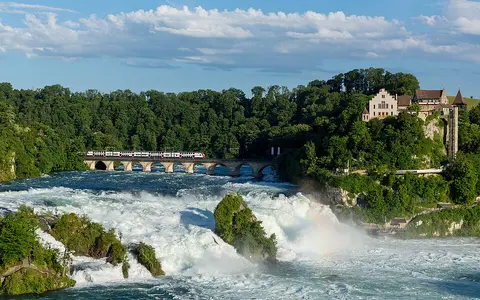

What Rhine Falls is
Rhine Falls lies on the High Rhine near Schaffhausen, close to the border between the cantons of Schaffhausen and Zurich. It is not a high mountain cascade; it is a broad river cataract set in a lowland-to-upland transition zone between the Swiss Plateau and the Table Jura.
The falls are best understood as a channel-scale obstacle on one of Europe's major rivers. Their physical form depends on a resistant limestone ledge, a plunge basin below the brink, and a river course shaped by Pleistocene glaciation.
Limestone brink and central rock
The visible waterfall edge is tied to hard Late Jurassic limestone exposed in the riverbed. Flow crosses this bedrock lip and drops into turbulent water below, while a prominent rock mass stands within the falls as a remnant of the resistant limestone structure.
Unlike waterfalls built on volcanic escarpments or hanging valleys, Rhine Falls is a river-width break in a mature drainage corridor. Its form is controlled more by bedrock contrast and channel history than by large local mountain relief.
Resistant limestone
Hard bedrock holds the broad waterfall lip in place.
Wide cataract front
The river descends across a broad segmented edge.
Plunge-zone erosion
Turbulence below the falls scours and reworks the receiving channel.
A waterfall from shifted Rhine drainage
The modern falls are linked to changes in Rhine course during the Quaternary ice ages. Earlier channels near Schaffhausen were filled with gravel, and later glacial conditions pushed the river into a course that crossed harder limestone beside more erodible sediment-filled ground.
That contrast helped establish the abrupt drop. The falls therefore record both bedrock resistance and the legacy of ice-age routing, not simply present-day river power.
High Rhine flow below Lake Constance
The High Rhine drains out of the Lake Constance system before reaching Rhine Falls. Lake storage moderates some sediment supply and flow variation, while snowmelt and seasonal runoff still influence discharge through the river corridor.
Average flow is commonly described as much higher in summer than winter, reflecting Alpine and pre-Alpine runoff patterns upstream. This makes the falls a discharge-focused waterfall record rather than a relief-focused one.
Swiss Plateau edge and European river connection
Rhine Falls sits in northern Switzerland within the larger Rhine basin, upstream of the Aare confluence and far upstream from the river's lower reaches toward the North Sea. Its local setting links plateau drainage, Jura-margin bedrock, and a long trans-European river system.
In atlas terms, the falls connect a compact landform to a much larger hydrologic corridor: the High Rhine carries water from Alpine and lake-influenced source areas into the western European lowlands.