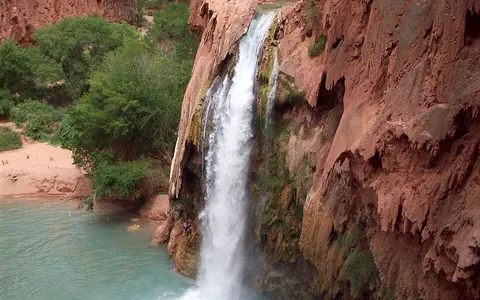
Overview
The falls lie on the Havasupai Reservation in Havasu Canyon, downstream from Supai. Havasu Creek descends about 110 feet (34 metres) over the main fall into a pool bounded by calcium-carbonate deposits. The waterfall is part of a longer sequence of falls, pools, and natural dams in the lower canyon rather than an isolated break in the channel.
110 ft / 34 m
The approximate descent from the travertine brink to the main pool.
Havasu Creek
A spring-fed tributary entering the Colorado River in Grand Canyon.
Travertine ledge
Calcium carbonate builds, cements, and reshapes the waterfall rim.
Canyon setting and relief
Havasu Canyon cuts into the southwestern Colorado Plateau as part of the Grand Canyon drainage network. Upstream, the normally dry channel is known as Cataract Canyon. Farther downstream it enters a bedrock canyon roughly 900 metres deep, exposing a staircase of nearly horizontal sedimentary strata.
Near the perennial reach, massive Redwall Limestone forms prominent canyon walls and helps control the larger relief steps. The waterfall itself occupies a younger carbonate construction within this much older rock-cut valley. Its form therefore combines two processes operating at different scales: long-term incision of a tributary canyon and continuing mineral deposition within the modern stream channel.
Springs, creek flow, and water colour
The upper drainage is largely ephemeral, but Havasu Creek becomes perennial where Havasu Springs discharge groundwater from the regional R-aquifer, chiefly through the Redwall Limestone. Recharge begins with rain and snow across the Coconino Plateau and adjacent uplands. Water then moves through permeable and fractured rock before emerging in the canyon, giving the lower creek a relatively steady base flow that is commonly below 2 cubic metres per second.
The spring water carries dissolved calcium, magnesium, and bicarbonate acquired during its subsurface passage. As carbon dioxide leaves the water and stream chemistry changes, calcium carbonate precipitates onto the bed, banks, plant material, and existing barriers. Fine carbonate material and pale mineral coatings contribute to the creek's characteristic blue-green appearance, especially where light passes through shallow water above a light-coloured bed.
Travertine growth and waterfall change
Fresh, porous calcium-carbonate deposits are often described as tufa; with continued growth and recrystallization they form more durable travertine. At Havasu Falls, these deposits reinforce the brink, rim the pool, and create smaller steps downstream. Carbonate can accumulate around twigs, algae, and irregular rock surfaces, gradually turning small roughnesses into channel-spanning barriers.
Deposition does not make the waterfall permanent in one exact shape. Flow shifts across the rim, carbonate seals some routes and builds others, and undercut sections can collapse. Ancient travertine remnants show that carbonate dams and falls have occupied Havasu Canyon for thousands of years, while the visible channel geometry can change much more quickly.
Dry climate and flash floods
The surrounding plateau is semi-arid, with high evaporation and long dry intervals. Groundwater storage sustains the creek between storms, but it does not remove flood risk. Intense summer thunderstorms and broader cool-season storms can send runoff from a drainage basin of roughly 2,900 square miles (7,500 square kilometres) into the narrow canyon.
During floods, the normally blue-green creek can become a sediment-laden red-brown torrent. High flows erode travertine rims, move gravel and boulders, fill pools, and create new channels or falls. The landform is thus shaped by the contrast between persistent spring discharge, which favours carbonate deposition, and short, powerful floods, which reorganize the deposits.
Colorado River connection
Below Havasu Falls, the creek continues through lower Havasu Canyon, crosses additional travertine steps, and reaches the Colorado River. Havasu Creek is one of the larger tributaries entering the river within Grand Canyon, and its clear spring flow, carbonate load, and occasional flood sediment all join the mainstem system.
This downstream connection places the falls within the wider erosional history of Grand Canyon. Uplift of the Colorado Plateau increased regional relief, while the Colorado River and its tributaries cut into the layered rocks. Havasu Falls occupies a locally constructive reach—where minerals build barriers—inside a drainage landscape dominated at the largest scale by incision and sediment removal.