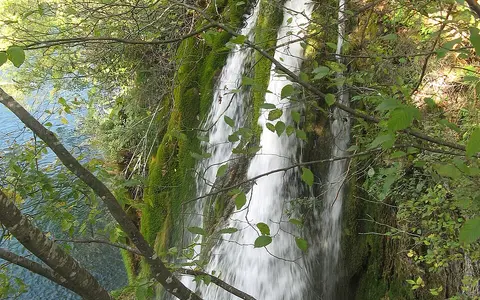

What Plitvice Waterfalls are
Plitvice Waterfalls are not a single named drop. They are the visible breaks in a stepped lake system where water moves from higher basins to lower basins across carbonate barriers.
The record is best understood as a chain of lakes, cascades, short falls, and canyon drops. The physical form depends on water chemistry as much as on relief: dissolved calcium carbonate precipitates as tufa, building porous barriers that impound lakes and create new spillways.
Tufa barriers and terraced lakes
The waterfall edges at Plitvice are tufa, a porous limestone deposit formed as carbonate-rich water releases carbon dioxide and calcium carbonate accumulates on submerged surfaces. Over time, these deposits raise barriers, back up water into lakes, and force overflow across rims and channels.
This makes the waterfall system dynamic. Drops can be partly buried, shifted, or divided as barriers grow and water finds new paths across the terraced lake margins.
Active tufa growth
Calcium carbonate deposition builds the natural dams that set waterfall positions.
Carbonate-rich flow
Karst water chemistry supports precipitation on mosses, algae, and other wet surfaces.
Segmented cascades
Flow is split among short falls, curtains, channels, and lake outlets.
Upper dolomite basins and lower limestone canyon
The Plitvice lake chain is divided into Upper and Lower Lakes. The Upper Lakes occupy less permeable dolomite terrain, where broader basins and gentler shorelines help retain water. The Lower Lakes are cut into a narrower limestone canyon, where steeper banks and tighter valley walls concentrate the final cascade sequence.
This contrast gives Plitvice its stepped profile: broad upstream lake surfaces, intervening tufa thresholds, and a lower canyon outlet where Sastavci falls and nearby inflow mark the beginning of the Korana River system.
Lake outflow, streams, and Korana connection
Water moves through the Plitvice system from lake to lake, with channels and overflow paths controlled by barrier height, seasonal discharge, and local seepage through karst rock. Kozjak is the largest lake in the chain and acts as a major through-flow body between the upper lake group and the lower canyon lakes.
At the lower end of the system, water from the lake chain meets the Plitvica stream near the Sastavci waterfall area. From there the Korana River drains away from Plitvice, linking the falls to a wider river corridor beyond the national park.
Mountain-karst water controls
Plitvice sits in a humid mountain-karst setting rather than an arid canyon or a glacial cliff. Precipitation, snowmelt, forested slopes, and groundwater movement all influence flow, while carbonate bedrock shapes both surface channels and underground pathways.
The waterfalls therefore respond to both runoff and chemistry. Sustained clean flow helps maintain tufa-forming conditions, while flood pulses, low-water periods, and sediment movement can alter individual cascades and the wet margins around them.