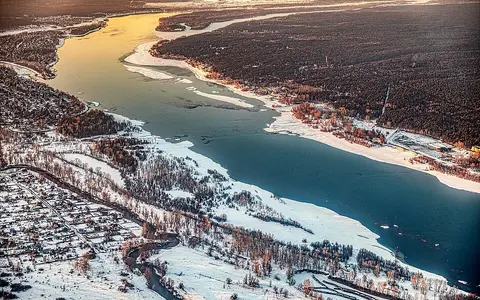

What the Ob River is
The Ob River is one of the principal river systems of western Siberia. It forms where the Biya and Katun rivers meet in the Altai foothill region, then flows generally north across Russia's West Siberian Plain.
As a physical geography record, the Ob is best understood as a broad basin rather than a single channel. Its route links mountain-margin runoff, the long Irtysh tributary system, lowland floodplains, taiga and peatland terrain, frozen-season hydrology, and a northern outlet through the Gulf of Ob to the Kara Sea.
Altai foothills and headwater junctions
The upper Ob begins near the northern side of the Altai Mountains, where the Biya and Katun rivers combine. These headwater streams drain higher terrain before the main river enters lower, flatter country.
This source arrangement gives the basin a strong contrast between upland runoff and downstream plain flow. The upper river has a clearer mountain-margin identity, while the middle and lower river become increasingly tied to wide valleys, floodplain storage, low banks, and slow gradients.
West Siberian Plain drainage
The West Siberian Plain is central to the Ob's geography. Across this broad lowland, small elevation differences strongly influence drainage patterns, waterlogging, floodplain width, and the spread of wetlands beside the main river and its tributaries.
The Ob-Irtysh system gathers water from a large part of interior Eurasia. The Irtysh, rising far to the southeast before joining the Ob, extends the basin's reach through mountain, steppe, and forest-margin landscapes before the combined system turns toward the Arctic coast.
Biya and Katun confluence
Mountain-fed source rivers meet near the Altai foothills to form the upper Ob.
Ob-Irtysh network
Large tributaries expand the drainage system across western Siberia and adjacent interior basins.
Gulf of Ob
The lower river enters a long estuarine gulf connected to the Kara Sea.
Floodplains, ice, and wetland storage
The Ob's flow is strongly seasonal. Snowmelt and spring thaw raise water levels across the basin, while winter ice cover alters channel behavior and can contribute to ice-jam flooding when thaw advances unevenly along the river.
Low relief makes floodplain storage especially important. Water spreads across side channels, backwaters, marshes, and peatland margins, so the river's physical record includes saturated ground and shallow floodplain water as much as the main channel itself.
Continental cold and northward transition
The basin spans strong continental climate zones, from southern interior source regions and tributary plains to colder taiga and subarctic lowlands. Long winters, snow storage, short thaw seasons, and summer rainfall all shape the timing of runoff.
Farther north, permafrost, tundra margins, river ice, and shallow coastal waters become more important. These cold-region controls help distinguish the Ob from temperate or monsoon river systems with warmer year-round flow conditions.
Gulf of Ob and Kara Sea margin
The lower Ob enters the Gulf of Ob, a long inlet of the Kara Sea on the Arctic Ocean margin. This outlet is not a compact delta like some river mouths; it is a broad transition where freshwater discharge, sediment, seasonal ice, and shallow marine conditions interact along a northern lowland coast.
The gulf completes the river's movement from Altai-adjacent source terrain through the West Siberian Plain to the Arctic shelf. That full sequence makes the Ob a useful atlas counterpart to the Lena River, another large Siberian river with cold-region hydrology and a northward outlet.