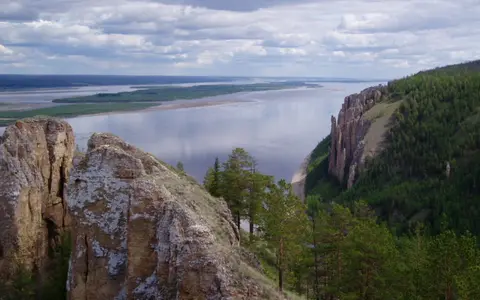

What the Lena River is
The Lena is one of the principal river systems of Siberia, flowing from the mountain and plateau country west of Lake Baikal toward the Arctic coast of Russia. It follows a generally northward route across a large continental basin before dividing into distributaries near the Laptev Sea.
In atlas terms, the river is best read as a cold-region drainage system rather than only a single channel. Its record includes highland source streams, tributary junctions, broad floodplain sections, frozen-season hydrology, and an Arctic delta built where river water, sediment, sea ice, and shallow coastal water meet.
Baikal-margin headwaters
The Lena rises in upland terrain near the Baikal Mountains, close to the larger rift-basin landscape that includes Lake Baikal. From these source areas the river turns away from the lake basin and begins a long course across eastern Siberia.
This source setting gives the Lena a strong upstream-to-downstream contrast. The upper river is tied to mountain slopes, confined valleys, and plateau runoff, while the lower river becomes a wider lowland system with more room for floodplain storage, meanders, islands, and distributary channels.
Uplands, plateaus, and lowland reaches
The Lena basin spans several physical settings in eastern Russia. Upper and middle reaches receive water from mountain and plateau catchments, while downstream sections cross lower-gradient plains where the valley broadens and the channel interacts more strongly with floodplain surfaces.
The river's main tributaries, including the Vitim, Olyokma, Aldan, and Vilyuy, expand the basin across uplands, taiga lowlands, and permafrost terrain. These tributaries are important because they turn the Lena from a regional headwater river into a basin-scale Arctic drainage system.
Baikal-adjacent uplands
Source streams begin in high ground near the Baikal mountain region before flowing into Siberia.
Tributary-fed interior corridor
Large side rivers connect plateaus, forests, lowlands, and cold continental catchments to the main stem.
Laptev Sea delta
The lower river spreads into distributaries on the Arctic coast before entering the Laptev Sea.
Snowmelt, ice, and seasonal flow
The Lena's flow regime is strongly seasonal. Winter freezing locks much of the river system beneath ice, while spring and early summer thaw release snowmelt runoff from the basin. That timing can produce high water when upstream reaches open before ice has fully cleared downstream.
Permafrost is a major control on the surrounding landscape. Frozen ground limits infiltration in many areas, influences surface drainage, and helps explain why floodplain wetlands, thaw-sensitive banks, and shallow waterlogged surfaces are part of the Lena's physical geography.
Continental cold and Arctic transition
The Lena basin lies under strong continental climate controls, with very cold winters, short thaw seasons, and large seasonal temperature differences. Farther north, the river enters an Arctic coastal setting where sea ice, tundra lowlands, and shallow shelf waters affect the outlet zone.
This climate structure separates the Lena from warmer monsoon or temperate river records. Its channel form, flood timing, bank stability, and delta processes all reflect the interaction of runoff with freeze-thaw cycles and cold-region ground conditions.
Delta at the Laptev Sea
Near the Arctic coast, the Lena divides into many channels across a broad delta plain. The delta sits at the transition from river floodplain to Laptev Sea coast, where sediment, distributary flow, permafrost landforms, seasonal ice, and shallow marine water overlap.
The outlet completes the river's northward continental route. Water gathered from the Siberian interior reaches the Arctic Ocean through a low coastal margin, making the Lena a clear example of how large rivers connect inland relief, cold-region hydrology, and polar shelf environments.