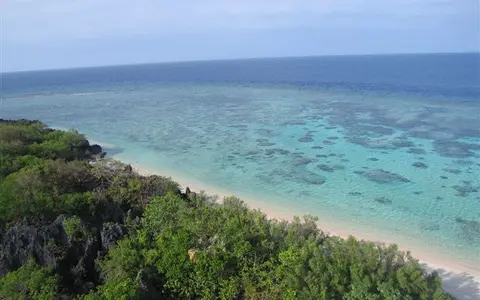

What Apo Reef is
Apo Reef is a mostly submerged coral reef system in the western waters of Occidental Mindoro. Its surface geography is small, but its marine footprint is much larger: reef platforms, shallow lagoon floors, patchy coral mounds, sand-bottom channels, cays, and limestone islets form the visible and submerged structure of the record.
In physical geography terms, Apo Reef is best read as an atoll-like platform inside a strait rather than as a shore-attached reef. It sits away from the Mindoro coast, is surrounded by open marine water, and belongs to the chain of island-sea passages that link the South China Sea side of the Philippines with the Sulu Sea and interior Philippine waters.
West of Occidental Mindoro
The reef lies in the Mindoro Strait, west of the municipality of Sablayan in Occidental Mindoro. It is offshore from the main island of Mindoro and east of the Calamian island group of northern Palawan, placing it in a marine corridor between large Philippine islands rather than beside a broad continental coast.
That position gives Apo Reef a gateway setting. Mindoro forms the eastern side of the strait, the Calamian Islands lie to the west and southwest, and the reef divides nearby waters into the Apo East Pass and Apo West Pass. The result is a reef system closely tied to passage geography, open-sea exchange, and island-arc bathymetry.
Lagoons, rims, channels, and surface islands
Apo Reef has a broad, roughly triangular plan with northern and southern atoll-like reef areas. Shallow reef platforms enclose lagoon water, while an east-west channel and smaller passages separate parts of the system and connect lagoon interiors with the surrounding strait.
The main geographic features are submerged, but three low landforms mark the reef above the water: Apo Island, Apo Menor or Binangaan, and Cayos del Bajo Tinangkapang. These are not high islands. They are small coral, limestone, sand, and vegetation surfaces perched on or near the larger reef platform.
Shallow lagoon rim
The northern reef includes a shallow enclosed lagoon and reef flats that may be exposed at low tide.
Deeper lagoon sector
The southern lagoon area is commonly described as deeper and more open along parts of its rim.
Small islands and cays
Apo Island, Apo Menor, and Cayos del Bajo show where the submerged reef rises into low emergent ground.
Low reef flats above strait depth
Apo Reef's relief is measured mostly across water depth rather than land height. Reef flats, cays, and lagoon floors form the shallowest parts of the system, while channels and outside slopes drop toward deeper parts of the Mindoro Strait.
The reef platform has also been interpreted as modern coral growth over older reef foundations that responded to late Quaternary sea-level change. That history matters because the present shape is not only a surface feature; it reflects reef construction, submergence, channel cutting, and changing sea level on an island-arc marine floor.
Marine exchange through passes and lagoons
Water movement around Apo Reef is controlled by the Mindoro Strait, tides, wind-driven surface flow, waves, lagoon flushing, and exchange through reef channels. Because the reef is offshore, it is less directly shaped by river mouths than many nearshore shelf reefs.
The internal lagoons still create local circulation patterns. Water can move across shallow reef rims, through gaps, over sand-bottom channels, and around coral mounds before mixing with the deeper strait. This hydrologic setting helps distinguish Apo Reef from coast-parallel barrier reefs with long mainland lagoons behind them.
Tropical monsoon setting and storm reworking
Apo Reef has a tropical marine climate shaped by warm seas, seasonal wind shifts, rainfall seasonality, and exposure within an open strait. Northeast and southwest monsoon patterns influence wave direction, surface drift, visibility, lagoon flushing, and the contrast between calmer and rougher sea states.
Storms and strong wind events are part of the reef's physical geography. They can move sand, coral rubble, and broken limestone across flats and cays, alter shallow passages, and reshape the margins of small emergent islands. The low surface features should therefore be understood as dynamic landforms.
Mindoro, Palawan, and Philippine reef geography
Apo Reef connects the geography of Occidental Mindoro with the Calamian Islands, northern Palawan waters, and the passage network between Philippine seas. Its strait setting makes it a regional marine landmark as well as a reef platform, because nearby channels organize water movement and island-to-island routes.
Within Geography Atlas, Apo Reef belongs in the reef hub as a Philippine atoll-like reef system. It pairs naturally with the Tubbataha Reefs because both are offshore Philippine reef records, while contrasting with coast-parallel barrier settings such as the Belize Barrier Reef and platform-margin examples such as the Andros Barrier Reef.