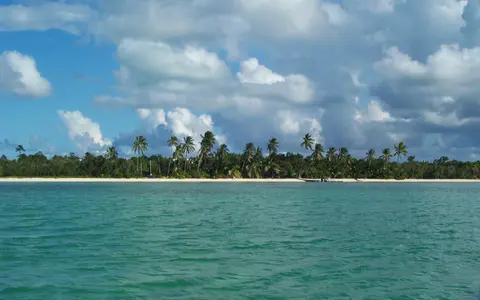

What the Andros Barrier Reef is
The Andros Barrier Reef is a long reef tract along the eastern margin of Andros, the largest island complex in The Bahamas. It is not a mainland coastal reef. It sits on a carbonate platform where limestone islands, shallow banks, tidal channels, reef flats, and steep submarine slopes meet in a compact physical system.
Its defining contrast is vertical as much as horizontal. Inshore waters, mangrove bights, flats, and nearshore shoals are shallow, while the seaward side faces the Tongue of the Ocean, a deep branch of the Great Bahama Canyon system. That abrupt bank-to-basin setting gives the reef its wall-like profile.
Along the eastern edge of Andros
Andros lies in the western Atlantic within The Bahamas, southwest of New Providence and west of the Exuma chain. The reef follows the island's eastern coast from the northern Andros area southward past central and southern sectors of the island complex.
The reef's position puts it between two contrasting Bahamian settings. To the east is the Tongue of the Ocean, a deep-water corridor separating Andros from New Providence and nearby banks. To the west and southwest are the broad, shallow flats of the Great Bahama Bank, where tidal creeks, mangroves, sand banks, and carbonate mud flats dominate the landscape.
Reef crest, reef wall, and bank flats
The reef includes shallow reef crest, reef flats, spur-and-groove relief, patch reefs, and a seaward slope that descends quickly into deeper water. In many places the physical sequence is compressed: shore and lagoonal shallows, a narrow reef tract, then the outside wall dropping toward the Tongue of the Ocean.
This differs from barrier systems with very broad lagoons behind them. Around Andros, the reef is tied closely to the edge of a carbonate bank and to the island's eastern shore, while the wider island complex opens westward into extensive flats and tidal wetlands.
Eastern platform margin
The reef marks the seaward side of Andros where shallow carbonate terrain meets deep Atlantic water.
Steep outside slope
The outside reef descends sharply toward the Tongue of the Ocean, creating strong depth contrast.
Flats and tidal cuts
Shallow banks, mangrove channels, and carbonate flats frame the reef from the Andros side.
Low limestone islands beside a deep trough
Andros is low-relief land built from carbonate rock, sand, mangrove wetlands, and tidal swamps rather than mountains or volcanic terrain. Its internal bights split the island complex, and its western side spreads into shallow bank flats.
The eastern reef introduces the strongest relief change in the system. The seabed moves from shallow bank and reef environments into the much deeper Tongue of the Ocean over a short distance, creating a steep submarine boundary along the island's Atlantic side.
Blue holes and carbonate dissolution
Andros is especially important to Bahamian geography because reef and bank landforms sit beside karst features. Blue holes, cave passages, sinkholes, and submerged depressions developed as carbonate rock dissolved during changing sea levels and groundwater conditions.
These features connect the reef record to the island's inland and nearshore geology. Ocean blue holes and tidal openings can link bank water, groundwater, and reef-margin circulation, while inland blue holes show that the same carbonate platform extends beneath forest, wetland, and settlement areas.
Tides, ocean exchange, and bank water
Water movement around the Andros Barrier Reef is shaped by Atlantic swell, trade-wind forcing, tidal exchange through cuts and bights, and the sharp depth gradient along the reef wall. The reef edge receives open-ocean water from the Tongue of the Ocean, while the island side includes calmer bank water, mangrove channels, and shallow tidal flats.
Unlike river-fed continental shelves, Andros has limited surface runoff. Rainwater largely moves through porous limestone, wetlands, and groundwater pathways, so the hydrologic pattern is strongly tied to karst, tides, evaporation, and exchange between bank flats and deeper ocean water.
Warm marine climate with storm exposure
Andros has a warm subtropical-to-tropical marine climate moderated by surrounding Atlantic water. Trade winds, seasonal rainfall, high humidity, and warm shallow banks influence water temperature, evaporation, and sediment movement along the reef and adjacent flats.
Hurricanes and tropical storms are part of the physical geography of the reef. Storm waves can cross reef crests, move sand and coral rubble, cut or deepen channels, erode low cays and shorelines, and reorganize shallow flats. Because Andros is low and carbonate-based, storm surge and overwash are major landscape processes rather than rare side notes.
Bahamian platform and Atlantic links
The Andros Barrier Reef belongs to the larger Bahamian platform system, where shallow carbonate banks are separated by deep channels such as the Tongue of the Ocean, Exuma Sound, and the Providence Channels. This gives the region a repeating pattern of pale bank flats, low islands, steep margins, and blue water.
Within the atlas, the record pairs naturally with the reef hub as a bank-margin barrier reef example. It also contrasts with the broad shelf-lagoon setting of the Belize Barrier Reef and the Florida platform setting described in the Florida Reef record.