![Image: ugraland [1] from Moscow, Russia](https://commons.wikimedia.org/wiki/File:Landscape_view_in_Circumpolar_Urals.jpg)
The mountains are not the whole Uralian belt
The UK Permanent Committee on Geographical Names lists Russian Ural’skiye gory (Уральские горы), conventional English Ural Mountains, and feature type “mountain range.” “The Urals” is the normal short English form. This page uses those names for the topographic mountain system; it does not use Urals for a federal district, economic region, or the much broader country on either side of the crest.
The Uralian orogen is a geological body defined by deformed crust, faults, sutures, and buried continuations. Puchkov emphasizes that it only partly coincides with the young, reactivated topography of the present mountains. Pay-Khoy and Novaya Zemlya to the north and the Mugodzhar uplands in Kazakhstan to the south are commonly described as geographic or structural continuations, but this record does not silently add them to the range's 2,500 km summary. Nor does it assign the mountain system a meaningful area: no cited source supplies a consistent mapped polygon. (Puchkov, 2009)
The PCGN coordinate 60°00′ N, 60°00′ E is useful for locating the elongated feature on a small-scale map, but it cannot describe its limits. The highest summit has a separate NGA-derived gazetteer position, 65°04′ N, 60°09′ E. These two coordinates answer different questions and must not be treated as competing fixes for the same point. Neither cited page specifies a geodetic datum, so both are retained only at the published precision. (PCGN, 2022 edition; NGA name record)
Five sectors, with the highest ground in the Subpolar Urals
The usual geographic sequence is Polar, Subpolar, Northern, Central (or Middle), and Southern Urals. The terms describe sectors of one long system rather than five separate ranges. Translated names vary: NASA uses “Nether-Polar” for the Russian Pripolyarnyy Ural, while “Subpolar” is common in English scientific literature. This page treats those two English forms as equivalents.
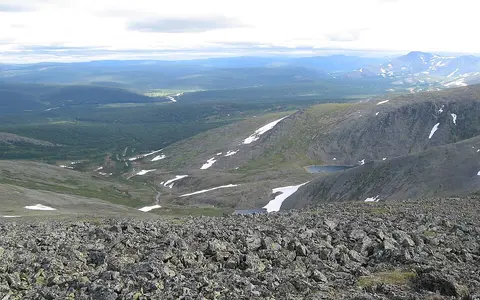
Relief is not uniform. The Polar and Subpolar sectors contain rocky ridges, cirques, trough valleys, snowfields, and small glaciers. The forested Northern Urals include dissected ridges and western foothills; the Central Urals are generally lower and form an easier passage between the plains; the Southern Urals broaden into multiple ridges, basins, limestone country, and isolated high massifs. The landscape is therefore not a continuous knife-edge wall. Its cross-range valleys and low sectors also mean that the conventional continental boundary does not everywhere follow the highest local crest.
Gora Narodnaya (Mount Narodnaya) is the range's highest summit at 1,895 m above sea level, or 6,217 ft after rounding. NASA places it in the Subpolar/Nether-Polar sector. The linked NGA-derived name record confirms the standardized romanized name and a coordinate of 65°04′ N, 60°09′ E but supplies no elevation; NASA supplies the height but does not state a vertical datum or survey edition. The atlas therefore retains whole-metre precision and does not imply a sub-metre survey. (NASA Earth Observatory; NGA name record)
Glacially shaped highlands
Cirques, troughs, frost-shattered rock, and small wind-fed glaciers distinguish the Polar and Subpolar sectors.
Lower forested crossings
Lower crests and transverse valleys weaken the idea of the range as an unbroken continental wall.
Parallel ridges and basins
Broader uplands include folded sedimentary rocks, crystalline belts, intermontane depressions, and karst terrain.
Ocean closure assembled a zoned mountain belt
An orogen is a belt of crust deformed during mountain building. The Urals record more than a single episode of “folding.” Puchkov's synthesis begins with Late Cambrian–Early Ordovician rifting and development of the Paleo-Uralian Ocean. Subduction and volcanic-arc activity followed; arc–continent collision reached the south in the Late Devonian and the north in the Early Carboniferous. Continent–continent collision between Laurussia and Kazakhstania began in the mid-Carboniferous, as Pangaea was being assembled, and most Uralian development continued through the Late Permian. (Puchkov, 2009)
The resulting structure is strongly zoned from west to east. Folded sedimentary rocks and the Pre-Uralian foredeep lie on the Laurussian side; the central suture includes faults, mélanges, and ophiolites—slices of former oceanic crust and upper mantle emplaced into the collision belt. Volcanic and intrusive rocks farther east record island arcs and active-margin magmatism. Deep seismic profiles across the Southern and Middle Urals reveal a two-sided, or bivergent, crustal architecture rather than a simple stack leaning in one direction. (Brown and others, 2008; Puchkov, 1997)
“Ancient mountains” can be misleading if it implies that today's ridges have stood unchanged since the Permian. The original collision relief was deeply eroded; parts of the belt were covered by younger sediment, and Puchkov reports renewed deformation in the Middle Jurassic and reactivation since the Oligocene. Brown and colleagues interpret the long post-collision history as predominantly erosion and slow exhumation. Present relief therefore reflects resistant rock belts, later uplift, river incision, frost action, and northern glaciation superimposed on Paleozoic structure. (Brown and others, 2008; Puchkov, 1997)
The crest separates several seas, not just Europe and Asia
Drainage changes along the range. In the Northern and Subpolar Urals, western-slope rivers including the Shchugor, Podcherem, Bolshaya Synya, Kosyu, and Kozhim feed the Pechora system and ultimately the Barents Sea. UNESCO's Virgin Komi documentation describes their steep, rocky mountain headwaters and the transition to slower channels on the Pechora Lowland. (UNESCO World Heritage Centre)
In the Central Urals, UNESCO's Visimskiy record provides a compact cross-divide example. The Sulem, Daria, and Shishim drain the western slope through the Chusovaya into the Kama–Volga system and the Caspian Sea. East of the dividing ridge, the Vogulka enters the Tagil and the Ob basin, which reaches the Kara Sea. The named catchments demonstrate that “Europe–Asia divide” and watershed are not synonyms: the former is a geographic convention, while the latter can be traced through connected channels. (UNESCO Man and the Biosphere Programme)
The Southern Urals divide more than two networks. Russia's Federal Agency for Water Resources identifies Volga-basin headwaters such as the Ufa, Ay, Yuryuzan, and Sim in the western mountain area of Chelyabinsk Oblast; east-slope rivers including the Miass and Uy enter the Tobol–Ob system; the Ural River basin occupies the south. For that administrative study area, the agency reports that 70–80% of runoff occurs during the spring high-water period. That percentage is a regional Chelyabinsk figure, not a constant for every Ural river. (Federal Agency for Water Resources)
Latitude sets the broad gradient; relief redistributes moisture
The 2,500 km span crosses a pronounced latitudinal sequence: Arctic tundra in the north, extensive boreal forest through much of the range, and forest-steppe and steppe toward the south. Elevation compresses that sequence locally, placing mountain tundra and bare rock above forest in the northern high sectors. NASA's summary is useful for this continental-scale transition, but it does not define climatic boundaries at a single latitude. (NASA Earth Observatory; UNESCO World Heritage Centre)
Prevailing westerly airflow and Arctic intrusions are modified by the north–south ridges. In the Northern and Subpolar Urals, the Virgin Komi nomination reports greater moisture on the western mountain slopes and names snow, wind exposure, slope aspect, and elevation as important local controls. In the Southern Urals, Panina and Nazarenko analyzed daily observations from 24 stations for 2004–2018; their mapping identifies orographic rain-shadow zones east and southeast of particular ridges rather than one uniform dry “eastern slope.” The measured contrast is therefore sector- and exposure-specific. (UNESCO World Heritage Centre; Panina and Nazarenko, 2020)
Small northern glaciers depend strongly on local snowdrift
Pleistocene ice carved cirques and troughs in the northern Urals, but modern ice is restricted to small glaciers in favorable high, shaded, and wind-loaded sites. A 2017 Journal of Glaciology study reports that the historical World Glacier Inventory listed 143 glaciers totaling 28.66 km² across the Polar and Subpolar Urals. That is an inventory-era figure, not a present-day count or area.
For a mapped Polar Urals study area, the researchers reconstructed 63 glaciers totaling 15.09 km² in the 1950s. Most were cirque or niche glaciers nourished heavily by redistributed snow. Change was uneven: IGAN Glacier lost 9.4% of its 1953 area by 1981 and then 30.2% of its 1981 area by 2008, while MGU Glacier lost 46% of its 1953 area by 2000 and a further 16% of its 2000 area by 2008. These differing reference years and denominators must remain explicit; the percentages cannot be combined into one range-wide loss rate. (Shahgedanova and others, 2017)
Data sources and publications
- Permanent Committee on Geographical Names for British Official Use. Russia: Toponymic Factfile, 2022, p. 11. Approved romanization, conventional English name, mountain-range classification, and 60° N, 60° E representative location.
- NASA Earth Observatory. The Ural Mountains, image acquired 13 July 2011, article dated 20 December 2015 (page updated 31 January 2026). Approximate 2,500 km range span, five-sector context, Subpolar/Nether-Polar location of the highest terrain, and 1,895 m (6,217 ft) Mount Narodnaya elevation.
- National Geospatial-Intelligence Agency name data, republished by Geographic.org. Gora Narodnaya, record modified 19 April 1994 (accessed 30 August 2026). Standard romanized and Russian names, mountain classification, and 65°04′ N, 60°09′ E coordinate; the record provides no elevation.
- Puchkov, V. N. “Structure and geodynamics of the Uralian orogen,” Geological Society, London, Special Publications 121 (1997), 201–236. Rifting, Paleo-Uralian Ocean, collision direction, rock assemblages, erosion, burial, and post-Paleozoic reactivation.
- Puchkov, V. N. “The evolution of the Uralian orogen,” Geological Society, London, Special Publications 327 (2009), 161–195. Distinction between the geological orogen and modern topography, Wilson-cycle sequence, and timing from rifting through recurrent orogenesis.
- Brown, D., Juhlin, C., Ayala, C., and others. “Mountain building processes during continent–continent collision in the Uralides,” Earth-Science Reviews 89 (2008), 177–195. Deep-seismic architecture, tectonic zoning, Late Paleozoic collision, erosion, and slow exhumation; principally Southern and Middle Urals.
- UNESCO Man and the Biosphere Programme. Visimskiy Biosphere Reserve (accessed 30 August 2026). Central Ural dividing-ridge setting and named Volga–Kama and Ob headwaters.
- Federal Agency for Water Resources, Russian Federation. Chelyabinsk Oblast: Water Resources (accessed 30 August 2026). Southern Ural headwaters in the Volga, Tobol–Ob, and Ural basins and the administrative study area's 70–80% spring-runoff share.
- UNESCO World Heritage Centre. Virgin Komi Forests and Virgin Komi Forests re-nomination (accessed 30 August 2026). Northern and Subpolar relief, western-slope Pechora tributaries, altitudinal zones, airflow, snow, and precipitation context. Site-specific measurements are not generalized to the full range.
- Panina, M. V., and Nazarenko, N. N. “Spatial distribution of temperature and precipitation in the South Ural Region,” IOP Conference Series: Earth and Environmental Science 579 (2020), 012085. Daily 2004–2018 observations from 24 stations and mapped topographic controls on temperature and precipitation.
- Shahgedanova, M., Nosenko, G., Bushueva, I., and Ivanov, M. “Changes in area and geodetic mass balance of small glaciers, Polar Urals, Russia, 1950–2008,” Journal of Glaciology, published online 8 September 2017. Inventory scope, imagery and survey dates, mapped areas, snowdrift controls, and glacier-specific change rates.