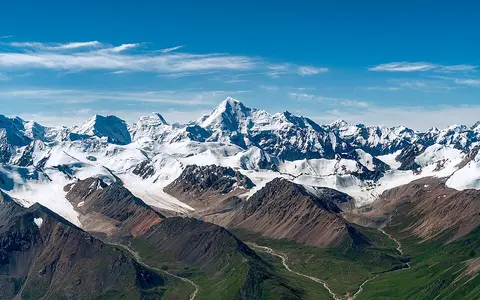

A range name with boundary-dependent totals
Tian Shan is the page’s English name; Tien Shan remains common in English-language scientific titles, while Tianshan is often written as one word. For the highest summit, Lifton and colleagues use the Kyrgyz name Jengish Choqusu, Chinese Tuo Mu Er, and Russian Pobeda Peak, and publish an elevation of 7,439 m above sea level. The source gives no vertical datum or new geodetic survey method, so the number is retained as a published elevation rather than implied centimetre-level geodesy. (Lifton and others, 2014)
This page covers the linked Tian Shan ranges and their enclosed basins across the four countries used by a recent range-wide glacier study. It does not use “Tian Shan” for all Central Asian highlands, the Pamir Mountains, Pamir-Alay, Dzungarian Alatau, Tarim watershed, or Xinjiang as a whole. The approximately 2,500 km length is consistent across geological studies, but their western end descriptions differ and no common surveyed polygon is supplied; for that reason this page gives neither a falsely exact area nor a single “centre” coordinate. (Li and others, 2023; Jolivet and others, 2010)
Ridges alternate with high sedimentary basins
The belt is a series of independent, generally east–west subranges rather than a continuous watershed. Western ranges include the Talas, Ugam, Pskem, and Chatkal; northern sectors include the Kyrgyz Ala-Too, Ile Alatau, and Kungey Ala-Too; central and inner sectors include the Terskey Ala-Too, Kokshaal Too, Ak-Shyirak massif, and the Jengish Chokusu–Khan Tengri highlands. Farther east, the Borohoro and other Chinese ranges divide the Ili, Bayanbulak, Turpan, and Junggar depressions. Published sector boundaries vary, so these names orient the reader rather than define a formal hierarchy. (Savoskul, 1997; Jolivet and others, 2010)
Relief changes markedly across those sectors. The northwestern frontal ranges have steep, narrow valleys, whereas the inner Tian Shan preserves broader, gentler high surfaces and sediment-filled basins. In the central high sector, deeply eroded valleys cut the massifs around Jengish Chokusu and Khan Tengri. In the central Chinese Tian Shan, Jolivet and colleagues describe intermontane basins separated by ranges reaching roughly 4,500–5,000 m; the enclosed Bayanbulak basin floor is about 2,400 m, with alluvial fans rising toward about 3,000 m. Those elevations describe that mapped study sector, not a range-wide mean. (Savoskul, 1997; Jolivet and others, 2010)
Old assembled crust is being shortened again
The rocks and the present relief have different histories. During the Paleozoic, island arcs and older continental fragments were accreted into the Central Asian Orogenic Belt. In the central Tian Shan, collision between the Tarim and Central Tian Shan blocks in Late Devonian–Early Carboniferous time was followed by collision with northern island arcs in Late Carboniferous–Early Permian time. Later strike-slip shear zones reworked those collision structures. The result is a basement mosaic of deformed sedimentary, volcanic, metamorphic, and granitic rocks rather than one uniform “fold mountain” sequence. (Jolivet and others, 2010)
Much younger compression created most present high relief by reactivating inherited weaknesses far north of the India–Asia collision. Reverse and oblique-slip faults raise basement blocks, fold basin sediment, and push mountain fronts outward into the Tarim and Junggar forelands. A 2010 solution using about 400 campaign GPS sites and 14 continuous stations measured 20 ± 2 mm per year of Tarim–Eurasia convergence across the Tian Shan at Kyrgyz longitudes, about 75°–80° E, and estimated 4–7 mm per year of Tarim underthrusting beneath the range. These are present-day kinematic rates for that transect, not long-term uplift rates or values for every fault. (Zubovich and others, 2010)
Paleozoic assembly
Former arcs, continental blocks, sutures, and shear zones supply the structural framework.
Crustal shortening
Thrust and oblique faults reactivate that framework as Tarim converges with Eurasia.
Ranges and basins
Uplifted blocks alternate with subsiding or sediment-filled intermontane depressions.
Westerly moisture weakens behind successive ranges
Mid-latitude westerly circulation is the main large-scale moisture source, while distance from the oceans produces large seasonal temperature ranges. The first northwestern slopes intercept much more moisture than the protected interior. In a nine-site comparison, stations near western glacier sites received as much as 1,500 mm per year, northern Kyrgyz Range sites received 600–800 mm per year, and central or inner sites near southern Terskey Ala-Too, Khan Tengri, and Ak-Shyirak received 310–430 mm per year. These are historical station-linked site values reported in 1997, not current normals for entire sectors. (Savoskul, 1997)
Seasonality also changes across the belt: western sites receive most precipitation in winter, whereas much of the inner and central Tian Shan has a late-spring or summer maximum. Elevation cools the high massifs enough for snow and ice, but exposure, slope direction, valley shading, and rain shadows determine where glaciers persist. The central range therefore cannot be summarized by one precipitation total or a simple “wetter with height” rule. (Savoskul, 1997; Saks and others, 2022)
Inventory method changes the count more than the total area
A recent comparison demonstrates why glacier totals need an inventory name and observation period. GAMDAM v2, whose Tian Shan outlines span 1994–2008 with about 70% dated 1998–2002, mapped 19,304 glaciers covering 11,685.0 km². Randolph Glacier Inventory v6, assembled from different Chinese and non-Chinese source inventories and dates, mapped 13,881 glaciers covering 11,826.7 km². The areas differ by only about 1%, but the counts differ by 5,423 because source dates, outline methods, headwall coverage, operator decisions, and treatment of seasonal snow differ. Neither number is a timeless total. (Li and others, 2023)
For change through time, an ensemble using satellite gravimetry, laser altimetry, and glacier modelling estimated that Tian Shan glacier area decreased by 18 ± 6% and glacier mass by 27 ± 15% between 1961 and 2012. That corresponds to 2,960 ± 1,030 km² of area loss and an average mass-change rate of −5.4 ± 2.8 gigatonnes per year over the stated period. Loss was spatially and temporally uneven, so the regional estimate should not be applied to an individual glacier. (Farinotti and others, 2015)
Large dendritic valley glaciers occupy the Jengish Chokusu–Khan Tengri sector. Northern and Southern Inylchek drain westward, while the Semyonov and Mushketov glaciers feed the Sary-Dzaz valley. At the Inylchek system, the ice-dammed Merzbacher Lake forms and drains seasonally, producing irregular meltwater pulses downstream through the Sary-Dzaz–Aksu system. This is a recurring glacier–lake process in one central catchment, not a drainage pattern for the full range. (Lifton and others, 2014)
Runoff divides among inland terminal basins
The principal hydrographic regions associated with the Tian Shan—Aralo-Caspian, Balkhash, Issyk-Kul, and Tarim—are endorheic, meaning their water terminates inland rather than reaching an ocean. Direction depends on the subrange. The Ili crosses from Xinjiang toward Lake Balkhash; the Aksu headwaters descend from the central Tian Shan to the Tarim system along the Taklamakan Desert; eastern streams enter the Junggar and Turpan depressions; and short rivers around Lake Issyk-Kul end in that closed lake. (Li and others, 2023; Luo and others, 2018)
Westward drainage links the mountain interior to the Syr Darya. The Big and Small Naryn join to form the Naryn, its major headwater tributary; the upper basin is enclosed by the Kyrgyz Ala-Too and Terskey Ala-Too to the north and the Ak-Shyirak, At-Bashi, Borkoldoy, and Ferghana ranges to the south. A model evaluated for 1981–2019 estimated glacier melt at about 23% of total annual runoff and 32% of summer runoff in the two upper catchments, with summer values ranging from 7% to 69% between years. Those modeled fractions describe the upper Naryn catchments and period only. (Saks and others, 2022)
Rivers also move the products of uplift and frost weathering. Confined mountain channels carry gravel, sand, and silt toward lower gradients; at range fronts they spread across alluvial fans and fill intermontane or foreland basins. Active faulting can tilt or fold those fans, while renewed incision cuts terraces into earlier deposits. The alternating ridges, basins, and fan aprons are therefore part of the mountain system’s ongoing construction, not merely lowland scenery. (Jolivet and others, 2010)
Data sources and publications
- Lifton, N., Beel, C., Hättestrand, C., and others. “Constraints on the late Quaternary glacial history of the Inylchek and Sary-Dzaz valleys from in situ cosmogenic 10Be and 26Al, eastern Kyrgyz Tian Shan,” Quaternary Science Reviews 101 (2014), 77–90. Range orientation and extent, summit names and elevation, central climate controls, named glaciers, valleys, and seasonal Merzbacher Lake drainage.
- Jolivet, M., Dominguez, S., Charreau, J., Chen, Y., Li, Y., and Wang, Q. “Mesozoic and Cenozoic tectonic history of the central Chinese Tian Shan: Reactivated tectonic structures and active deformation,” Tectonics 29 (2010), TC6019. Published 2,500 km extent, Paleozoic assembly, Cenozoic reactivation, subranges, basin elevations, faults, fans, and terraces.
- Zubovich, A. V., Wang, X.-q., Scherba, Y. G., and others. “GPS velocity field for the Tien Shan and surrounding regions,” Tectonics 29 (2010), TC6014. Network size, 20 ± 2 mm per year central-transect convergence, Tarim underthrusting, and the geographic limits of those rates.
- Savoskul, O. S. “Modern and Little Ice Age glaciers in ‘humid’ and ‘arid’ areas of the Tien Shan, Central Asia: two different patterns of fluctuation,” Annals of Glaciology 24 (1997), 142–147. Sector terminology, relief contrasts, station-linked precipitation ranges, seasonality, and glacier-climate differences.
- Li, F., Maussion, F., Wu, G., and others. “Influence of glacier inventories on ice thickness estimates and future glacier change projections in the Tian Shan range, Central Asia,” Journal of Glaciology 69 (2023), 266–280; published online 2022. Four-country study scope, hydrographic regions, GAMDAM v2 and RGI v6 dates, counts, areas, methods, and modeled ice-volume uncertainty.
- Farinotti, D., Longuevergne, L., Moholdt, G., and others. “Substantial glacier mass loss in the Tien Shan over the past 50 years,” Nature Geoscience 8 (2015), 716–722. Satellite and modeling ensemble, 1961–2012 glacier-area and mass change, absolute area loss, rates, and uncertainties.
- Luo, Y., Wang, X., Piao, S., and others. “Contrasting streamflow regimes induced by melting glaciers across the Tien Shan–Pamir–North Karakoram,” Scientific Reports 8 (2018), article 16470. Basin map and named west- and east-directed drainage links, including Ili–Balkhash and Aksu–Tarim.
- Saks, T., Pohl, E., Machguth, H., and others. “Glacier Runoff Variation Since 1981 in the Upper Naryn River Catchments, Central Tien Shan,” Frontiers in Environmental Science 9 (2022), article 780466. Upper Naryn setting, model period and evaluation data, precipitation seasonality, glacier-volume change, and annual and summer meltwater fractions.