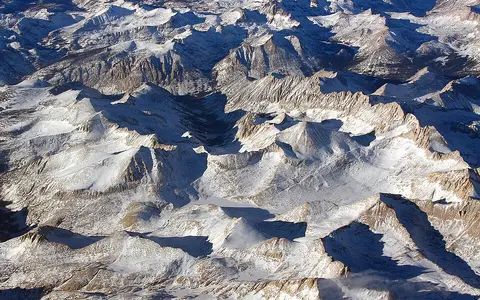

The California–Nevada range, not every region called Sierra Nevada
Sierra Nevada is the federally recognized name and the feature is classed as a range in the U.S. Geological Survey's Geographic Names Information System (GNIS), feature ID 253582. “The Sierra” is a common shortened form. This record concerns the North American physical range; it does not describe Spain's Sierra Nevada, a park boundary, the Sierra Nevada Conservancy's administrative region, or every ecological area that carries the name. (USGS National Map Gazetteer; GNIS guidance)
The range lies mostly in eastern California and extends into a small part of western Nevada. At Lake Tahoe, descriptions may distinguish the main Sierra Nevada west of the basin from the Carson Range on the east, even though broader geologic treatments include both in the Sierran setting. The state line crosses the physical system and does not define a mountain front. The page therefore follows the whole named range shown by the 2026 California Geological Survey–USGS Earth Science Atlas, while labelling Tahoe and Carson Range statements at their narrower scale. (CGS Sierra Nevada Earth Science Atlas)
Rounded dimensions between volcanic cover and desert faults
The National Park Service describes the Sierra Nevada as approximately 640 km (400 mi) long; its Yosemite synthesis gives a width of 80–130 km (50–80 mi). These are rounded, map-scale descriptions because the foothills and northern volcanic cover do not form a closed surveyed boundary. The range trends mainly northwest–southeast despite often being summarized as north–south. (NPS Sierra Nevada Geodiversity Atlas; NPS Yosemite geology)
Northward, the exposed Sierran bedrock passes beneath Cenozoic volcanic rocks at the southern Cascade Range and Modoc Plateau transition. Southward, the Garlock fault and Mojave margin separate the Sierra Nevada geomorphic province from the Tehachapi Mountains and desert ranges. The Great Valley—Sacramento Valley in the north and San Joaquin Valley in the south—lies to the west. Owens Valley, Mono Basin, the Tahoe basin, and other Basin and Range lowlands lie along the east. California Geological Survey Note 36 calls the west flank a gentle surface averaging about 2°, contrasted with the rugged, multiple fault scarp on the east; that average is not a slope angle for every canyon or ridge. (California Geological Survey, Note 36)
Mount Whitney is both the high point and the GNIS range locator
Mount Whitney, on the boundary of Sequoia National Park and Inyo National Forest near the southern crest, is the highest summit in the Sierra Nevada and the contiguous United States. The National Park Service reports 4,421 m (14,505 ft), NAVD 88. An older USGS reference table retains 14,494 ft from the 1985 Mount Whitney quadrangle and labels the source as the National Geodetic Survey; USGS now marks that compilation as historical reference. The values should not be averaged or interpreted as eleven feet of mountain growth: the datum-labelled NPS figure is used here, while the older mapped value is retained only to explain the discrepancy. (NPS Mount Whitney; USGS historical summit table)
The July 2026 National Map Gazetteer service stores the Sierra Nevada range feature at 36.578551° N, 118.293437° W. GNIS rules place the primary coordinate for a summit, ridge, or range at its highest point and use the North American Datum of 1983 (NAD 83). This coordinate therefore locates the Mount Whitney high point; it is not a centroid, does not define the range limits, and should not be used to infer that most of the range lies in Whitney's county. (USGS National Map Gazetteer, data refreshed July 2026; GNIS coordinate guidance)
A batholith assembled from many intrusions
The Sierra Nevada batholith is not one uniform mass of “granite.” The 1:400,000 geologic compilation published in 2026 groups the range's foundation into older Paleozoic and Mesozoic metamorphosed sedimentary and volcanic wall rocks, numerous plutons and intrusive suites that cut those rocks, and younger sedimentary, volcanic, and surficial deposits that overlap them. A batholith is a composite body of intrusive igneous rock; a pluton is one magma body that cooled below the surface. (Graymer and O'Neal, USGS–CGS geologic map, 2026)
Subduction along western North America generated repeated magmatic episodes, after which erosion stripped off much of the volcanic cover and exposed the deeper intrusions. In Yosemite's central-Sierra sample, most granitoids date from 105–85 million years ago; that interval describes local Cretaceous plutons, not the age of the entire batholith or the modern topography. Resistant, massive rock supports domes and cliffs, while joints, faults, roof pendants, and contrasts among rock units guide weathering, valleys, and passes. (NPS Yosemite geology)
Plutons, not one slab
Many intrusive bodies collectively form the batholith and cut older metamorphic wall rocks.
Volcanic and sedimentary units
Younger rocks overlap the older framework, especially toward the northern transition and in local basins.
Structure guides erosion
Rock strength and fractures help determine whether erosion leaves domes, cliffs, passes, or deep canyons.
Westward tilt and an active eastern fault system
“Fault-block range” describes the broad topographic structure, not a claim that one fault created every summit. Faulting along the eastern margin raised and westward-tilted the Sierran block during the past several million years, and movement continues. The long western flank descends beneath Great Valley sediment, whereas closely spaced normal faults and down-dropped basins create the short, steep eastern escarpment. Rivers responded to uplift by cutting deep west-slope canyons; east-slope streams descend over a shorter horizontal distance into Owens Valley, Mono Basin, and adjoining basins. (NPS Sierra Nevada Geodiversity Atlas; CGS Note 36)
Relief also changes along the range. The crest is lower and more broken around northern passes and Tahoe, then commonly exceeds 4,000 m in the southern High Sierra. The southern range can have two prominent crest lines: Mount Whitney stands on the eastern crest, while the Great Western Divide rises farther west. Summit elevation above a vertical datum and local relief above an adjacent valley are different quantities; the page reports the former and does not manufacture a range-wide relief figure.
Glaciers enlarged river valleys on both sides of the crest
Repeated Pleistocene glaciers began in high cirques and followed pre-existing river canyons, widening them into U-shaped troughs, truncating spurs, leaving hanging tributary valleys, polishing bedrock, and depositing moraines. Cirques and sharp arêtes cluster near the crest; the western slope contains longer glacial troughs where ice followed the gentler regional gradient. The Yosemite area provides a mapped example rather than a range-wide ice inventory: the local Tioga glaciation comprised several advances from about 27,000 to 15,000 years ago, with maximum extent about 21,000–18,000 years ago, and ice covered most of the mapped area above 2,700 m. (USGS Scientific Investigations Map 3414)
Ice crossed some low divides and flowed both west into the Tuolumne, Merced, and San Joaquin systems and east toward the Mono and Owens basins. Modern Sierra glaciers are much smaller and formed during later Holocene climate fluctuations; they are not leftover fragments of the Tioga ice. Water, frost cracking, rockfall, debris flows, and river incision now continue the work of moving bedrock and sediment downslope. (NPS Yosemite geology)
Pacific rivers, a closed southern basin, and Great Basin sinks
On the northern and central west slope, the Feather–Yuba and American systems reach the Sacramento River, while the Cosumnes, Mokelumne, Stanislaus, Tuolumne, Merced, and upper San Joaquin drain toward the San Joaquin River and Sacramento–San Joaquin Delta. That route ultimately reaches San Francisco Bay and the Pacific. South of the San Joaquin watershed, however, the Kings, Kaweah, Tule, and Kern rivers enter the Tulare Lake Basin. EPA treats it as a separate watershed with no natural surface-water outlet under present conditions; historically its lakes and wetlands could spill toward the San Joaquin during sufficiently wet periods. The former page's claim that all west-slope water ultimately reached San Francisco Bay was therefore too broad. (U.S. EPA, San Francisco Bay Delta and Tulare Lake watersheds)
East of the main crest, runoff enters the hydrographic Great Basin. Lake Tahoe drains through the Truckee River to Pyramid Lake; the Carson reaches Carson Sink and the Walker reaches Walker Lake. Other crest streams terminate in Mono Lake or feed the Owens River and Owens Lake basin. These are endorheic drainages—surface water ends inland rather than reaching an ocean. Reservoirs, diversions, and interbasin aqueducts now alter many downstream routes, but they do not change which side of the natural divide a headwater occupies. (USGS Truckee River Basin; USGS Water-Supply Paper 271)
Cool-season storms, elevation, and a leeward rain shadow
Pacific storms supply most precipitation during the cool season. Air forced up the western slope cools and condenses; higher terrain receives more of that water as snow. After crossing the crest, descending air warms and dries, reinforcing the aridity of Owens Valley and the western Great Basin. Latitude, elevation, slope aspect, and storm track all matter, so one precipitation total or climate class cannot represent the foothills, crest, and eastern basins together.
Snowpack is a seasonal water store, not a fixed range statistic. Snow water equivalent (SWE) is the depth of liquid water contained in the snow. California's Cooperative Snow Surveys program reports Northern, Central, and Southern Sierra values from more than 265 snow courses and 130 sensors across the Sierra Nevada and Shasta–Trinity region; those network counts and geographic scope are as published on the program page in 2026. Since 2021, DWR comparisons have used a 1991–2020 averaging period. A percentage of average must therefore identify its date, Sierra region, and reference period; this page intentionally carries no transient “current snowpack” number. (California DWR Snow Surveys; DWR reference-period note)
Runoff timing also varies. A USGS analysis of 24 gages in 20 Sierra Nevada watersheds separated the first spring snowmelt pulse, peak daily snowmelt discharge, and late-season base flow; it found stronger range-wide synchrony in a wet year than in a dry year and showed that snow storage, bedrock permeability, and soil depth alter the response. Warm rain falling on existing snow can instead produce large rainfall floods on west-slope basins. These processes explain why “snow-fed” does not mean steady flow or a single melt date. (USGS Scientific Investigations Report 2005-5056, version 1.1; USGS Scientific Investigations Report 2012-5130)
A mountain boundary, not an administrative one
The Sierra Nevada is a major part of the North American Cordillera but is not a subrange of the Rocky Mountains. Its northern bedrock transition meets the southern Cascade volcanic province; its southern front ends against the Mojave and Tehachapi region; and its east front borders internally drained Basin and Range country. The state boundary, national-park boundaries, and water-management regions cross or subdivide these physical relationships rather than defining them.
Use the Mountain Hub to compare range-scale structure, the Cascade Range record for the volcanic transition to the north, the Lake Tahoe record for a fault-bounded basin between Sierran ranges, and the Great Basin Desert record for the leeward interior beyond the crest.
Data sources and publications
- California Geological Survey. California Geomorphic Provinces, Note 36, text revised 2002. Approximate length, west-slope angle, eastern multiple scarp, glacially modified canyons, and northern and southern geomorphic boundaries.
- California Geological Survey and U.S. Geological Survey. Sierra Nevada Earth Science Atlas, Geologic Data Map 9, 2026; Graymer, R., and O'Neal, M. D., Geologic map of the Sierra Nevada, California and western Nevada, scale 1:400,000. Range scope and mapped rock-unit framework.
- U.S. National Park Service. Geodiversity Atlas—Sierra Nevada Inventory & Monitoring Network (accessed 30 August 2026). Approximate 640-km extent, adjoining provinces, asymmetric relief, batholith summary, and glacial landforms.
- U.S. Geological Survey, The National Map. National Map Gazetteer / GNIS REST service, data refreshed July 2026, feature ID 253582; and U.S. Board on Geographic Names, GNIS data guidance (accessed 30 August 2026). Official name, feature class, coordinate, NAD 83 datum, and highest-point convention for range coordinates.
- U.S. National Park Service, Sequoia & Kings Canyon National Parks. Seeing and Climbing Mt. Whitney, updated 25 August 2025. Summit setting and 4,421 m (14,505 ft) NAVD 88 elevation.
- U.S. Geological Survey. Elevations of Named Summits Over 14,000 Feet Above Sea Level (accessed 30 August 2026; historical-reference compilation). Older 14,494-ft Mount Whitney figure from the 1985 quadrangle.
- U.S. National Park Service, Yosemite National Park. Geology (accessed 30 August 2026). Range width, fault-block structure, pluton definition, Yosemite granitoid ages, erosion, and modern-glacier distinction.
- Wahrhaftig, C., Stock, G. M., McCracken, R. G., Sasnett, P., and Cyr, A. J. Extent of the Last Glacial Maximum (Tioga) glaciation in Yosemite National Park and vicinity, California, U.S. Geological Survey Scientific Investigations Map 3414, 2019, doi:10.3133/sim3414. Mapped glacial chronology, elevation scope, and flow directions.
- U.S. Environmental Protection Agency. About the San Francisco Bay Delta Watershed, updated 13 January 2026. Sacramento, San Joaquin, and Tulare Lake watershed routes and the present lack of a natural Tulare surface-water outlet.
- U.S. Geological Survey. Science in the Truckee River Basin, published 4 November 2024; and Surface Water Supply, 1909, Part XI, Water-Supply Paper 271, 1911. Truckee outlet and snow source, plus the Carson, Walker, Mono, and Owens terminal drainage framework.
- California Department of Water Resources. Snow Surveys (accessed 30 August 2026); and DWR Conducts May 1 Snow Survey, 1 May 2023. Monitoring-network scope, SWE reporting, regional series, and 1991–2020 reference period.
- Peterson, D. H., Smith, R. E., Stewart, I., Knowles, N., Soulard, C., and Hager, S. W. Snowmelt Discharge Characteristics, Sierra Nevada, California, U.S. Geological Survey Scientific Investigations Report 2005-5056, version 1.1, 2005. Twenty-four-gage snowmelt timing, wet–dry variability, and geologic controls on runoff and base flow.
- Lamontagne, J. R., Stedinger, J. R., Berenbrock, C., Veilleux, A. G., Ferris, J. C., and Knifong, D. L. Development of Regional Skews for Selected Flood Durations for the Central Valley Region, California, U.S. Geological Survey Scientific Investigations Report 2012-5130, 2012. Rainfall and rain-on-snow flood classification based on data through water year 2008.