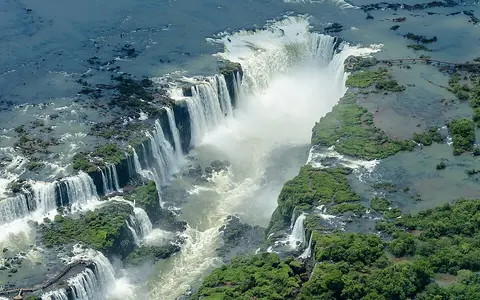

What Iguazu Falls is
Iguazu Falls is not a single narrow drop. It is a wide waterfall complex where the river splits around islands and pours over multiple basalt ledges.
The falls record is defined by river volume, resistant bedrock, plunge pools, spray zones, and downstream gorge incision.
Basalt ledges and cataract islands
Basalt layers and fractures help divide the river into many falls. Islands and channels distribute flow across the brink before water enters the gorge.
Multiple drops
The river breaks across a wide, uneven edge.
Downstream incision
Falling water and turbulent flow help cut the gorge below.
Parana link
The falls connect directly to a major South American river system.
Forest margins and spray zones
Spray, mist, and river turbulence create a humid edge environment around the falls. This local setting belongs to the physical record because it follows from water volume and drop geometry.