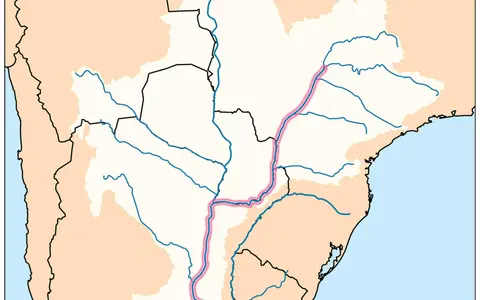

What the Parana River is
The Parana flows through Brazil, Paraguay, and Argentina, gathering tributaries across a wide basin before joining the Rio de la Plata system.
Its geography combines plateau runoff, bedrock controls, reservoirs, floodplain wetlands, and a downstream estuary connection.
Plateau tributaries and lowland reaches
Upper and tributary sectors drain plateau country where bedrock, gradient, and rainfall help set channel form. Lower reaches include broader floodplains and wetland margins.
This makes the Parana a useful counterpart to the Amazon and Orinoco, with a more temperate-subtropical basin profile.
Iguazu-linked river geography
The Iguazu River joins the Parana after passing through the Iguazu Falls region, giving the wider system an important waterfall and gorge connection.
Plateau runoff
Tributaries gather water from uplands and interior basin margins.
Bedrock and reservoirs
Falls-linked reaches and large reservoirs mark parts of the system.
Rio de la Plata
The lower river joins a broad estuarine outlet toward the Atlantic.
Wetlands, islands, and channel belts
Lower Parana reaches include broad channel belts, islands, wetlands, and floodplain lakes. These features store water and sediment during seasonal high flow.
The river's lowland sectors therefore belong alongside its more abrupt bedrock-controlled sections.
Joining the Rio de la Plata system
Downstream flow reaches the Rio de la Plata, where river discharge, sediment, tides, and estuarine form create a wide Atlantic-facing transition.
This outlet completes the basin's interior-to-coast sequence.