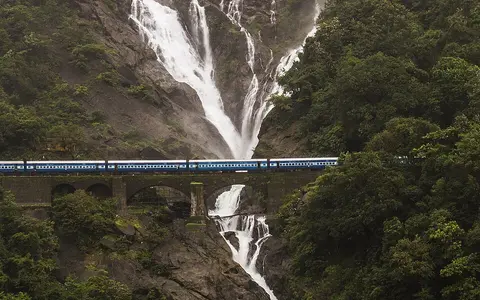

Monsoon escarpment setting
The falls are shaped by seasonal rainfall and steep relief along the Western Ghats. During high flow, the waterfall expands across the rock face and becomes much more forceful.
Goa’s official account places Dudhsagar on the Goa–Karnataka border, at a steep, curved valley head surrounded by tropical forest. It describes water dividing into three streams as it descends towards a pool. This gives the waterfall a broader geographical setting: the visible cascade occupies a break in the mountain slope, with a receiving valley below. The same account identifies the monsoon as the period of especially powerful flow. Government of Goa: Dudhsagar Waterfalls
Forested gorge and plunge pools
Falling water, spray, and runoff connect the upper escarpment to forested lower slopes and plunge-pool zones.
Monsoon runoff
Rainfall seasonality controls flow.
Steep Ghats relief
Escarpment height creates the fall.
Forested gorge
Dense slopes frame the downstream channel.
The river beyond the waterfall
The Water Resources Department’s Citizen’s Charter describes the Dudhsagar river as originating in Karnataka, entering Goa at Kuveshi and flowing west towards the Mandovi. It also identifies a Khandepar tributary entering Goa near Caranzol and joining the Dudhsagar. These named connections place the falls within a drainage network that crosses a state boundary. Water leaving the cascade continues through that network; the pool below the falls is not the endpoint of the river. Goa Water Resources Department: Citizen’s Charter
This river description also helps interpret the tourism portal’s broader reference to Mandovi headwaters. A waterfall can belong to the Mandovi drainage system while a more detailed account names its local river separately. For atlas reading, the useful distinction is between the waterfall itself, the river reach carrying its water and the larger basin receiving that flow. The departmental account supplies those connections without requiring an assumed discharge or an invented catchment area.
White water, name and scale
The name Dudhsagar is translated as “sea of milk”. Goa’s official description connects it with the pale foam produced by the falling water. The name therefore records a conspicuous visual quality of the cascade. The portal also recounts a princess-and-milk legend associated with the falls; that is a cultural explanation of the name, rather than evidence for how the landform developed. Government of Goa: name and legend
Published official height figures need qualification. Goa Tourism Development Corporation gives 1,017 feet, approximately 310 metres, whereas the state portal gives 600 metres from head to foot. The cited descriptions do not reconcile this difference or establish a shared measurement method. Consequently, the smaller figure is presented here as GTDC’s reported height, rather than a newly verified survey measurement. The disagreement also makes an exact national or worldwide height ranking inappropriate on this evidence. GTDC: Falls; state portal comparison
Protected landscape and seasonal management
GTDC places the waterfall within the jurisdiction of Bhagwan Mahavir Wildlife Sanctuary. Its description of the approach combines travel towards Kulem with a final journey through rugged terrain and a walking section. This protected landscape is part of the waterfall’s geographical context: the forested approach and the cascade belong to the same visitor setting. GTDC’s account describes the route in general terms, but does not establish that any particular journey is currently permitted. GTDC: sanctuary and approach
Seasonal management provides a documented example of the relationship between rainfall, wildlife and access. In a notice dated 24 May 2024, Goa’s Department of Information and Publicity announced closure of the Dudhsagar tourism circuit to vehicle movement from 1 June 2024. The stated reasons were wildlife proliferation and the approaching monsoon. That historical notice shows why the season of dramatic waterfall flow need not coincide with unrestricted access. It is evidence of a specific closure decision, not a timetable for subsequent years or confirmation of today’s opening status. 2024 tourism-circuit closure notice