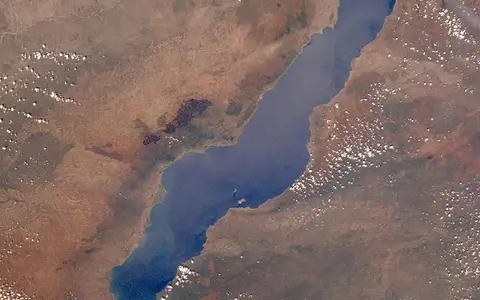

One lake with three national names
The UK Permanent Committee on Geographical Names lists Lake Nyasa (Lake Malawi) as its recommended form and records the national usage as Lake Malawi in Malawi, Lake Nyasa in Tanzania, and Lago Niassa in Mozambique. Its 12°00′S, 34°30′E position is best treated as a map reference for the feature: the lake is hundreds of kilometres long, and that point neither defines its center nor resolves international boundaries.[1]
A 2023 scientific synthesis gives 29,500 km² for lake area, while the 2025 PCGN factfile rounds the area to 29,600 km². Neither source supplies a survey date or water level for the outline, so this page uses “about 29,500 km²” rather than presenting the 100 km² difference as physical change. The 97,740 km² land catchment quoted by the same synthesis is a separate measurement; it is not part of the lake surface.[1][2]
A north–south water body between rift uplands
Malawi occupies the long western and southern side of the lake; Tanzania reaches its northeastern shore and Mozambique its eastern and southeastern shore. Likoma and Chizumulu are physical islands in the east-central lake and are administered by Malawi although surrounded by Mozambican waters. These political arrangements do not alter the physical extent of the lake.[1]
At the north end, the Malawi Rift approaches the Rungwe volcanic province. Along the eastern side of the North Basin, the Livingstone Fault runs for more than 120 km and places deep water close to a steep fault margin. Farther south, the Central Basin deepens toward the Usisya fault system on the western side. The shallower southern end widens before water leaves near Mangochi, enters the Upper Shire, and passes through Lake Malombe on its route toward the Zambezi.[3][5]
Extension built linked half-grabens
The Malawi Rift is a seismically active, magma-poor part of the East African Rift System. As the crust extends, blocks drop along normal faults—faults on which the overlying block moves downward. Each resulting asymmetric depression is a half-graben. Border faults and intervening accommodation zones divide the lake floor into North, Central, and South basins rather than one simple trench. [3]
Seismic imaging shows the North Basin sediment wedge thickening eastward toward the Livingstone Fault, while the Central Basin thickens westward toward the Usisya Fault; the deepest lake floor lies in the Central Basin. A three-dimensional refraction model found as much as approximately 5 km of sediment deposited during rifting beneath parts of the North and Central basins.[3] An onshore study in northern Malawi placed local rift initiation near 8.6 million years ago and the first lacustrine sediment there at roughly 4.5–4.0 million years ago. Those dates describe the northern geological record, not the age of the present shoreline or its water.[4]
Deep central trough, gentler southern floor
The 2023 synthesis compiles a maximum length of 570 km, a width varying from 25 to 75 km, a mean depth of 294 m, and a maximum depth rounded to 700 m. Modern geophysical work independently describes the lake as 25–80 km wide and about 700 m deep.[2][3] The familiar 706 m figure is a more precise catalogue value, whereas a 1974 survey summary reported 695 m. Because the sources represent different bathymetric compilations, “approximately 700 m” is the defensible atlas figure.[6][7]
Basin asymmetry explains the uneven shores. Fault-footwall sectors can descend rapidly offshore, leaving little shallow shelf. On the opposing ramp sides, gradients are gentler and rivers can build deltas and broader littoral plains. The southern lake is much shallower than the Central Basin; an archived bathymetric summary does not reach 200 m depth until about 110 km north of the southern end. [7]
Deepens eastward
Sediment thickens toward the Livingstone border fault along the Tanzanian margin.
Deepest water
The lake's maximum bathymetric depression lies beside the Usisya fault system.
Shallow outlet sector
The floor rises southward toward the arms and the Upper Shire outlet at Mangochi.
Rain on the lake is as important as tributary flow
The land catchment covers about 97,740 km² across the three riparian countries. The Ruhuhu in Tanzania drains 14,070 km², the largest tributary catchment; the South Rukuru in Malawi drains 12,110 km². Other named inflows include the Bua, Dwangwa, Linthipe, Songwe, Kiwira, Mbaka, Lufilya, and North Rukuru. These rivers deliver runoff and sediment to local deltas, but direct precipitation onto the lake's large surface is also a major input.[2]
The 2023 synthesis reproduces compiled annual estimates of approximately 41 km³ of direct rain and 29 km³ of river inflow, balanced principally by about 54 km³ of evaporation and 12 km³ through the Shire. The rounded inputs total 70 km³ and the outputs 66 km³, so they should be read as approximate values assembled from underlying records, not as a closed budget for one stated year or period. [2] Evaporation is therefore the dominant loss, even though the lake normally has a surface outlet.
The Shire connection depends on lake level
Water leaves the southern lake at Mangochi and travels roughly 410 km down the Shire before reaching the Zambezi in Mozambique. The physical connection is controlled by a shallow outlet threshold. A 2020 hydrological model reports that Shire outflow ceases when the lake falls below approximately 471.5 m above sea level; the paper does not specify a vertical datum for that elevation. During the low-water interval from 1910 to 1924, the lake fell below the threshold and had no outflow. [5]
Lake level normally rises through the November–April rainy season and reaches its annual maximum from March to May, then declines as dry-season inputs weaken and evaporation and discharge exceed them. Since 1965, releases farther down the Upper Shire have also been regulated at Kamuzu Barrage, so recent lake levels and outflow reflect both climate and operating decisions. The lake is thus hydrologically open at ordinary levels but can become temporarily closed during severe low stands. [5]
Cool-season winds tilt and mix the upper lake
Lake Malawi is meromictic: its deep water does not mix completely with the surface in the regular seasonal cycle. Classic measurements found water below about 250 m near 22.5°C and without dissolved oxygen, while the upper lake develops a seasonal thermocline—a depth zone across which temperature changes rapidly. Complete overturn was not observed in that study. [6]
From May to August, cooler air and persistent southerly or southeasterly Mwera winds deepen mixing in the upper water column and push warm surface water northward. The tilted thermocline allows cooler deep water to upwell in the shallow southern arms. When winds vary, the thermocline oscillates as an internal seiche—an underwater standing wave. From September, weaker winds and warmer surface water restore stronger stratification; most rain falls from November to April. [2][6]
Sources and measurement notes
- United Kingdom Permanent Committee on Geographical Names, Malawi: Toponymic Factfile, pp. 5–6 (July 2025; accessed 29 August 2026). Source for the recommended and national names, three-country attribution, approximate map reference, 29,600 km² catalogue area, and the status of Likoma and Chizumulu. The PDF text layer drops the first “2” from the lake latitude; 12°00′S, 34°30′E was cross-checked against the J. Paul Getty Trust's direct Thesaurus of Geographic Names record.
- Chavula, G. M. S. et al., “Lake Malawi/Niassa/Nyasa basin: Status, challenges, and research needs”, Journal of Great Lakes Research 49(6), 102241 (2023). Source for name usage, lake and land-catchment dimensions, tributary catchments, compiled water-balance figures, seasonal winds and mixing, and the Shire route. Its morphometric table is largely compiled from the 1999 Lake Malawi/Nyasa Water Quality Report and does not give a survey date, outline method, or vertical datum.
- Accardo, N. J. et al., “Constraints on Rift Basin Structure and Border Fault Growth in the Northern Malawi Rift From 3-D Seismic Refraction Imaging”, Journal of Geophysical Research: Solid Earth 123, 10003–10025 (2018). Source for the active magma-poor rift setting, three half-graben basins, accommodation zones, Livingstone and Usisya fault geometry, central maximum depth, and up to approximately 5 km of syn-rift sediment beneath the imaged North and Central basins.
- Ring, U. and Betzler, C., “Geology of the Malawi Rift: kinematic and tectonosedimentary background to the Chiwondo Beds, northern Malawi”, Journal of Human Evolution 28(1), 7–21 (1995). Source for the northern onshore chronology of rift initiation and initial lacustrine sedimentation. These dates should not be read as the age of the modern lake level or shoreline.
- Bhave, A. G. et al., “Lake Malawi's threshold behaviour: A stakeholder-informed model to simulate sensitivity to climate change”, Journal of Hydrology 584, 124671 (2020). Source for rainy-season timing, annual level cycle, the approximately 471.5 m outflow threshold, the 1910–1924 closed interval, the Shire–Lake Malombe sequence, and the history of barrage regulation. The article reports elevations as metres above sea level without naming the vertical datum.
- Eccles, D. H., “An outline of the physical limnology of Lake Malawi (Lake Nyasa)”, Limnology and Oceanography 19(5), 730–742 (1974). Source for the 560 × 75 km survey description, 695 m then-reported maximum depth, deep-water temperature and oxygen conditions, incomplete mixing, internal waves, and southern upwelling.
- International Lake Environment Committee Foundation, World Lake Database: Lake Nyasa (Lake Malawi) (archived lake record; accessed 29 August 2026). Source for the later 706 m catalogue depth and the bathymetric description of the steep northern and eastern shores and gentler southern floor. Several other numeric fields in the current HTML table are visibly truncated or inconsistent, so they are not used here.