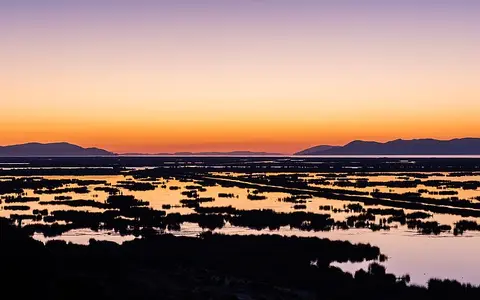

One international lake, not the whole Altiplano watershed
The international boundary crosses the lake: Peru occupies the western and northern shores and Bolivia the eastern and southern shores. Puno stands beside the broad Bay of Puno on the Peruvian side; Copacabana lies on the peninsula that helps separate the main basin from the southeastern water body. Isla del Sol rises northeast of that peninsula, and the Cordillera Real forms the high eastern skyline. An approximate 16° S, 69° W coordinate is useful for locating the lake, but is not a surveyed centroid, deepest point, or boundary coordinate.[4]
The water body is commonly divided into Lago Mayor or Lago Grande, also called Lago Chucuito, and the southeastern Lago Menor, also called Huiñaymarca or Wiñaymarca. These are physical sub-basins of Lake Titicaca, not separate entries here. The Strait of Tiquina connects them; Bay of Puno is a shallower western embayment of the larger basin. The binational authority explicitly distinguishes Lago Mayor, Bay of Puno, and Lago Menor in its bathymetric description.[1]
“Titicaca basin” can mean either the lake's contributing catchment or the northern part of the much larger TDPS interior-drainage system. This record uses lake for the standing water and contributing catchment for the land that drains directly to it. A 2025 model delineated about 48,780 km² of contributing land, from lake level to summits near 6,300 m; ILEC's 58,000 km² catalog figure uses an undocumented catchment convention and should not be substituted without qualification.[2][3]
A deep main basin beside a shallow southern basin
The most recent lakewide bathymetric campaign replaced 1976–1978 charts with measurements collected by the Peruvian and Bolivian hydrographic services in 2016–2019. The two national teams standardized their method, established geodetic control for the shore and soundings, positioned survey lines with dual-frequency GPS, and measured depth by echo sounder. The integrated 1:100,000 chart was completed and presented in 2021.[1]
A 2025 analysis using that survey reports a 277 m maximum depth and a mean storage volume of 958 km³. The authority's summary page rounds volume to about 930 km³, while ILEC's older compilation gives 893 km³, 107 m mean depth, and 8,372 km² of surface. The publications do not establish one shared reference lake level, shoreline date, or recalculation method, so this page keeps the modern 277 m–958 km³ pair together and treats the catalog set as an alternative—not evidence of rapid physical gain or loss.[1][2][3]
Lago Mayor contains the broad open water and the mapped maximum. Lago Menor is much shallower: a 2023 sediment study summarizes mean depths of about 125 m for Lago Mayor and 9 m for Lago Menor. A metre of lake-level change therefore shifts shallow southern shorelines and storage proportionally more than it changes the deep basin.[4]
Deep open-water basin
The northern and central basin holds the deepest water and most lake storage.
Narrow connecting strait
A bedrock-and-peninsula constriction links the two water bodies rather than dividing two independent lakes.
Shallow, responsive margins
Low-gradient shores, bays, islands, and reed shallows make water-level movement conspicuous.
Water occupying a tectonic intermontane depression
Titicaca occupies the northern Altiplano, a sediment-filled depression raised between the Western and Eastern Cordilleras during Andean mountain building. “Tectonic lake” describes the basin's structural setting; it does not mean that one fault event created the modern shoreline. Folding, faulting, uplift, river deposition, glacial erosion in the surrounding ranges, and changing outlet thresholds all helped shape the accommodation space in which water and sediment accumulated.[5]
Terraces and lacustrine deposits record several earlier northern-Altiplano lakes at levels different from modern Titicaca. The mapped Quaternary sequence includes the Mataro, Cabana, Ballivián, Minchin, and Tauca highstands, but these names refer to reconstructed palaeolake phases and sometimes to water bodies extending into adjoining basins. They should not be presented as a simple series of former names for one unchanged lake.[5]
A 136 m sediment core from Lago Mayor preserves about 370,000 years of alternating wetter and drier conditions. Glacial intervals in that record generally coincide with deeper, fresher water; some interglacial intervals produced shallower closed-basin conditions. The core demonstrates long-lived lake sedimentation and repeated hydrological reorganization, but does not date the initial tectonic depression or justify a single exact “age of Lake Titicaca.”[6]
Rain-fed tributaries and a level-sensitive outlet
The Ramis, Coata, Ilave, Huancané, and Suchez are the five large tributaries used in the classic 1956–1987 discharge compilation. They enter mainly from the north and west, except the Suchez from the northeastern highlands; smaller Peruvian and Bolivian catchments drain directly to bays and reed margins. The historical study found that roughly 80% of river input arrived from January through April, with the Ramis peak tending toward March and the combined peak otherwise in February. Those proportions describe that observation period, not a timeless river-flow forecast.[7]
Water leaves through evaporation and the Desaguadero River at the southern end of Lago Menor. The river runs south across the Altiplano toward the lower Poopó basin. Because discharge depends strongly on lake stage and on shallow outlet-channel controls, “only outlet” does not mean constant outflow. The rating curve used in the recent water-balance model was derived from a 1993 hydrodynamic study and referenced to the Peruvian vertical datum; the model authors flag the age of that relationship.[2]
For 1982–2016, the 2025 model estimated average annual inputs equivalent to 744 mm of direct lake precipitation and 958 mm of catchment inflow. Estimated losses were 1,616 mm by evaporation and 121 mm by downstream outflow: 93% and 7% of total losses respectively. These are lake-surface-equivalent depths from a calibrated model, not direct measurements at every river or an expectation for every year; the reported water-balance closure error was −15 mm per year.[2]
Tropical summer rain in a cold high basin
Titicaca lies near 16° S, inside the tropics, yet thin air and high elevation keep the basin cool. In the 2025 model domain, annual mean air temperature ranged from about −2 °C in the highest catchments to 11 °C over the warmer lake area, averaging 6 °C. The water stores solar heat and reduces the daily temperature range along nearby shores; it also helps organize local convection and precipitation over the open lake.[2][7]
Most precipitation falls during the austral summer wet season, when easterly upper-level circulation helps carry Amazonian moisture onto the Altiplano. Winter is dry. Cordillera relief produces strong local contrasts: high ridges intercept or block humid air, while lower passes admit it. Although snow and glaciers occur on high summits, the 1982–2016 catchment model found a rainfall-dominated regime; snowmelt supplied about 6% of modeled precipitation-plus-melt input and snow-and-ice processes had little influence on simulated lake-level variation at whole-catchment scale.[2][8]
The shoreline moves on seasonal and multiyear timescales
Lake elevation is not a fixed 3,812 m plane. Monthly SENAMHI records for 1921–2018 show a clear annual cycle: levels usually peak from March to May after the summer rains and reach minima from November to January. A published analysis placed the observed 1915–2009 extremes near 3,806.7 m in 1944 and 3,811.6 m in 1986, a range of about 5 m in that particular series and datum.[8]
That long record also contains biennial, interannual, and longer-period variability, so one low or high year is not by itself a persistent trend. Rain and river inflow vary far more between years than evaporation does; with only a small, stage-sensitive river loss, the lake integrates wet and dry sequences over time. Shallow Lago Menor, the Bay of Puno, river deltas, and low reed margins therefore show the largest horizontal shoreline shifts, while the deep floor of Lago Mayor remains submerged.[2][4]
The upper water store of the TDPS chain
The lake stands at the north and topographic head of the Titicaca–Desaguadero–Poopó–Coipasa system. Water that crosses the Desaguadero sill moves south toward progressively lower, drier Altiplano basins, where it is further reduced by evaporation. Poopó and the Coipasa salt basin are therefore downstream connections, not parts of Lake Titicaca's own surface or equivalent permanent lakes.[1][5]
Compare Titicaca's high tectonic plateau setting with the much deeper active-rift trough of Lake Tanganyika and the broad, shallower plateau basin of Lake Victoria. The lake hub and terrain index provide wider navigation without extending this record into travel, administrative, or whole-watershed coverage.
Sources and measurement notes
- Autoridad Binacional Autónoma del Sistema Hídrico TDPS (ALT), Batimetría del lago Titicaca (survey work 2016–2019; integrated chart completed and presented in 2021; accessed 29 August 2026). Binational primary source for official Spanish usage, lake and TDPS scope, sub-basin names, earlier chart history, survey method, vertical-control benchmarks, and the authority's approximate 930 km³ volume, 176 km length, and 70 km width. The overview figures are rounded and do not state a common reference lake stage.
- Lima-Quispe, N., Ruelland, D., Rabatel, A., Lavado-Casimiro, W., and Condom, T., Modeling Lake Titicaca's Water Balance: The Dominant Roles of Precipitation and Evaporation, Hydrology and Earth System Sciences 29 (2025), 655–682 (accessed 29 August 2026). Source for the approximately 8,340 km² working surface, 48,780 km² contributing-land area, catchment elevations and temperatures, 277 m maximum depth and 958 km³ mean volume derived from the 2016–2019 bathymetry, 1982–2016 modeled water balance, rainfall-dominated regime, Desaguadero rating-curve datum and limitations, and level sensitivity. Modeled fluxes are not presented as direct discharge observations.
- International Lake Environment Committee Foundation, World Lake Database: Lake Titicaca (SAM-04) (database page accessed 29 August 2026). Compiled alternative set of 8,372 km² surface area, 107 m mean depth, 893 km³ volume, 1,125 km shoreline, and 58,000 km² catchment. The entry does not identify a shared survey date, shoreline resolution, lake stage, or datum, so its figures are disclosed but not mixed into the modern bathymetric set.
- Guédron, S., et al., Holocene Variations in Lake Titicaca Water Level and Their Implications for Sociopolitical Developments in the Central Andes, Proceedings of the National Academy of Sciences 120 (2023), e2215882120 (accessed 29 August 2026). Sediment-core and historical-level source for the approximate 16° S, 69° W locator, the two-basin distinction, cited 125 m and 9 m mean depths, sensitivity of the shallow basin, the Desaguadero overflow relationship, and Holocene lake-level change.
- Lavenu, A., Formation and Geological Evolution, in Dejoux, C., and Iltis, A. (eds.), Lake Titicaca: A Synthesis of Limnological Knowledge (Kluwer Academic Publishers, 1992), pp. 3–15 (accessed 29 August 2026). Geological synthesis for the intermontane Altiplano setting, tectonic and depositional controls, Quaternary palaeolake sequence, changing thresholds, and the distinction between reconstructed highstands and the modern lake.
- Fritz, S. C., et al., Quaternary Glaciation and Hydrologic Variation in the South American Tropics as Reconstructed from the Lake Titicaca Drilling Project, Quaternary Research 68 (2007), 410–420, doi:10.1016/j.yqres.2007.07.008 (corrected repository version; accessed 29 August 2026). Drilling source for the 136 m Lago Mayor sediment core, approximately 370,000-year record, and alternation between deeper freshwater and shallower closed-basin states. It does not date the tectonic origin of the entire basin.
- Roche, M. A., Bourges, J., Cortes, J., and Mattos, R., Climatology and Hydrology of the Lake Titicaca Basin, in Dejoux, C., and Iltis, A. (eds.), Lake Titicaca: A Synthesis of Limnological Knowledge (Kluwer Academic Publishers, 1992), pp. 63–88 (accessed 29 August 2026). Measurement-period source for tributary names, 1956–1987 discharge seasonality, rain-shadow geography, lake moderation of temperature, Desaguadero behavior, and legacy 1968–1987 water-balance estimates. Newer headline water-balance values on this page come from reference 2.
- Sulca, J., Apaéstegui, J., and Tacza, J., New Insights into the Biennial-to-Multidecadal Variability of the Water Level Fluctuation in Lake Titicaca in the 20th Century, Frontiers in Climate 5 (published January 2024), 1325224 (accessed 29 August 2026). Analysis of SENAMHI monthly levels for 1921–2018 and atmospheric data; source for the seasonal timing of high and low water, the approximately 1915–2009 extreme range cited from prior work, and multi-timescale variability and Amazonian moisture transport.