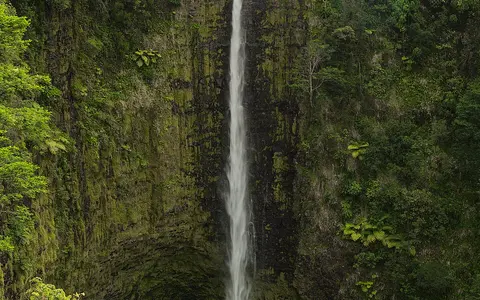

Windward island setting
The falls lie inland from the Hāmākua coast, where streams drain the wet northeastern flank of Hawaiʻi Island toward the Pacific Ocean. This places the waterfall within an ocean-island drainage system rather than a large continental river basin. Go Hawaiʻi places ʻAkaka Falls along the northeastern Hāmākua corridor.
Relief rises from the coast toward the island interior, and the falls mark an abrupt break in the stream's downstream profile.
Volcanic gorge and plunge form
Hawaiʻi Island's volcanic terrain provides the setting for the gorge. Hawaiʻi State Parks describes a free-falling drop of 442 feet into a stream-eroded gorge, equivalent to about 135 metres. This is a rounded published height, not a new measurement.
In general, resistant rock can help maintain a waterfall brink, while falling water and transported sediment can erode rock around a plunge pool. These are geomorphic explanations, not verified measurements of rock resistance or erosion at Akaka Falls. A 1998 USGS account identifies the plunge pool but explicitly treats retreat of the falls as an inference from other waterfalls, stating that it was not being measured.
The waterfall is chiefly a single plunge rather than a broad stairway of cascades. Its narrow fall links the stream brink with the recessed gorge below.
Rainfall, streamflow, and climate controls
Moist trade winds approaching from the northeast rise over the island's higher ground. Orographic rainfall—rainfall produced when moist air rises over higher ground—helps supply windward streams. The Rainfall Atlas of Hawaiʻi explains this regional climate process; it does not establish how quickly flow at Akaka Falls responds to an individual storm.
In general, steep, small catchments can respond quickly to heavy rainfall, but the sources cited here do not establish a response time for Kolekole Stream at the falls. Rainfall and catchment wetness provide context for changing flow; rapid response at this particular waterfall should not be treated as a documented observation. The bedrock lip, vertical drop, and incised gorge—formed by incision, meaning a stream cutting down into rock—provide the landform setting.
About 135 m
A rounded published height for the near-vertical plunge into the gorge.
Kolekole Stream
A short windward drainage flowing from the island slope toward the Pacific.
Volcanic gorge
Stream erosion into volcanic terrain frames the narrow fall and plunge zone.
Regional drainage connection
Below the falls, Kolekole Stream continues through lower windward terrain to the ocean along the Hāmākua coast. The sequence from humid upland catchment to gorge, waterfall, lower channel, and coastal outlet illustrates how rainfall and steep volcanic relief organize drainage on a large oceanic island. Akaka Falls is both a local break in channel gradient—the steepness of a stream's course—and part of the broader transfer of water and eroded material from Hawaiʻi Island's interior slopes to the Pacific margin.