
What the Murray-Darling system is
The Murray-Darling system combines the Murray River, Darling River, and many tributaries across southeastern Australia.
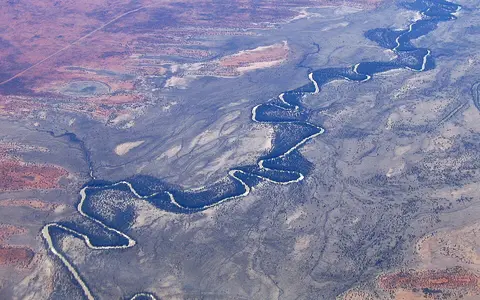
Its physical geography is defined by dryland variability, long low-gradient channels, broad floodplains, and wetlands that respond strongly to seasonal and multi-year flow changes.
Upland margins and interior plains
Eastern uplands supply important runoff, while much of the basin crosses flatter inland plains where channels may split, rejoin, and interact with floodplain wetlands.
This makes the system a useful comparison with the Indus and other dryland river records.
Murray, Darling, and basin branches
The system is organized by joined river branches rather than one simple mainstem. Tributaries enter from upland and lowland catchments, often with highly variable discharge.
Eastern upland runoff
Higher terrain supplies flow to tributaries feeding the wider basin.
Low-gradient channels
Long river reaches cross flat inland terrain with floodplain wetlands.
Southern coast
The lower Murray reaches coastal lakes and the Southern Ocean margin.
Variable rainfall and floodplain wetlands
Flow can vary strongly between wet and dry periods. Floodplain wetlands, lakes, and anabranch systems expand during higher flow and contract during drought.
This variability is central to the basin's physical geography.
Lower Murray and coastal lakes
The lower system reaches lakes and coastal barriers near the Southern Ocean. River discharge, evaporation, sediment, and coastal exposure all influence the outlet zone.
This completes the system's sequence from upland runoff to dryland plains and coastal transition.