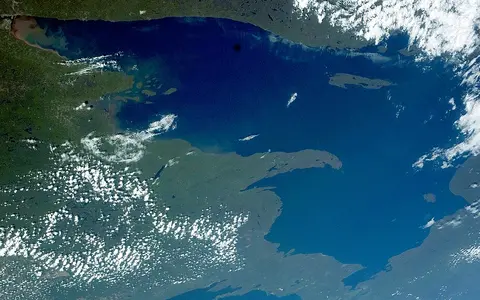

A binational lake, not its whole catchment
This record covers the standing water body from the Duluth–Superior end in the west to Whitefish Bay and the head of the St. Marys River in the east. It does not treat the 127,700 km² land-drainage area, the wider 209,800 km² land-and-water basin, or the St. Marys River as parts of the lake itself. The international boundary crosses the water; Ontario borders the north and east, Minnesota the western end, and Wisconsin and Michigan the south.[2]
The Canadian Geographical Names Database records the lake as a polygon and supplies a map-reference point at 48°02′26″ N, 86°40′41″ W (48.0406606, −86.6780149), relevant at 1:5,000,000 scale. This is a locating coordinate, not a surveyed centroid, deepest-point position, or definition of the border. The same record recognizes Lake Superior and Lac Supérieur as official; the 2022 binational lake plan also records the Anishinaabeg name Gichigami.[1][5]
Published catchment figures are not interchangeable. The coordinated table gives 127,700 km² of land drainage and 209,800 km² for land plus lake, whereas the 2022 binational plan prints 43,153 km² for the “watershed” without reconciling that boundary with the coordinated drainage area. This page retains the explicitly labelled coordinated figures and does not merge the smaller value into them.[2][5]
Rifting made the weakness; ice enlarged it
Lake Superior follows the Lake Superior arm of the Midcontinent Rift, an ancient zone where continental crust stretched, subsided, and erupted enormous volumes of basalt between about 1,109 and 1,094 million years ago. Subsidence continued after extension stopped, and rivers and lakes deposited thick clastic sediment—broken rock carried by water—over the volcanic pile. Later compression partly inverted the structure, raising resistant volcanic ridges around and within the basin.[8]
The rift did not create today's water-filled outline directly. Repeated Pleistocene ice sheets exploited the lower, softer sediment-filled depression and sculpted the modern basin; the most recent regional glaciation ended roughly 10,000 years ago. Resistant lava flows form features such as Isle Royale, Keweenaw Peninsula, and parts of Minnesota's North Shore, while post-rift sandstone is exposed around the Apostle Islands and Pictured Rocks. The resulting pattern explains why deep troughs, bedrock headlands, islands, and sedimentary reaches occur side by side.[8]
Dimensions anchored to low water
NOAA's coordinated physical table gives a length of 563 km and maximum breadth of 257 km, alongside 82,100 km² of water surface. These are generalized lake-scale dimensions, not straight shoreline traverses. Its 4,385 km shoreline figure includes islands and depends on the mapping scale and treatment of small inlets; it should not be read as a uniquely exact coastline length.[2]
Mean depth, maximum depth, and volume are referenced to Low Water Datum. For Lake Superior, the current navigation-chart plane is 183.2 m (601.1 ft) on International Great Lakes Datum 1985. It is a fixed reference surface, not the lake's present elevation: observed water levels move with precipitation, runoff, evaporation, outflow, wind, and longer wet–dry cycles. NOAA is preparing IGLD 2020, but IGLD 1985 remains the operational reference at this review.[6]
The 12,100 km³ headline volume is the coordinated figure, not a claim that every published calculation agrees. EPA lists four compiled estimates from 11,600 to 12,230 km³, with different source methods and an average of 12,004 km³. Keeping the coordinated 12,100 km³ value makes the stat set internally consistent while leaving the published spread visible.[2]
A smoother west, deep centre, and ridged east
The floor is not a single smooth bowl. Canadian Hydrographic Service sailing directions describe a comparatively smooth northeast–southwest-trending western basin where depths greater than 183 m are common. The main deep basin between Isle Royale and the Keweenaw Peninsula is cut into relatively soft late Precambrian sedimentary rock and exceeds 300 m in places. In the eastern third, long ridges separate troughs commonly 244–305 m deep; the 406 m lake maximum is in the southeastern part of the lake.[3]
Relief also rises abruptly. Escarpments around the Shield margin stand about 122–244 m above adjacent land while nearby water can reach 152–274 m depth. Superior Shoal is an exceptional mid-lake high with only 6.4 m of water over it, about 85 km east of Isle Royale. NOAA's available lakewide bathymetry is a draft 3-arc-second grid—roughly 90 m cells—referenced horizontally to NAD 83 and vertically to lake Low Water Datum. It is suitable for regional floor form, not fine navigation or centimetre-scale claims.[3][4]
Broad and comparatively smooth
Deep water occupies a northeast–southwest depression, with Isle Royale separating it from the northwestern shore.
More than 300 m in places
Softer sedimentary rocks between Isle Royale and Keweenaw underlie much of the central deep water.
Ridges and 244–305 m troughs
Irregular relief culminates in the 406 m maximum in the southeastern part of the lake.
Rocky margins alternate with mobile deposits
The 2022 binational assessment classifies about half of the coast as rocky shore and cliff, 14% as cobble beach, and 10% as sand beach. Bedrock dominates much of the high-relief north shore and the volcanic Isle Royale–Keweenaw alignment. Large embayments interrupt that rim: Thunder Bay, Black Bay, and Nipigon Bay on the north; Chequamegon Bay in Wisconsin; Keweenaw Bay in Michigan; and Whitefish Bay near the outlet.[5]
Lower coasts are active sediment systems. Around the Apostle Islands, waves erode sandstone and glacial bluffs; the released sand is transported alongshore into beaches, spits, tombolos, and cuspate forelands. A tombolo is a bar that joins an island to the mainland, while a cuspate foreland is a roughly triangular projection of deposited sediment. Waves, seasonal ice, and changing water levels therefore reorganize exposed shores even though the lake basin itself is bedrock controlled.[9]
Precipitation, runoff, diversions, and one outlet
Direct precipitation on the lake is the largest water input in the 2003 balance reproduced by the binational lake plan. Hundreds of tributaries drain the surrounding uplands; major examples include the Nipigon, St. Louis, Kaministiquia, Pic, Bad, and Ontonagon rivers. Surface runoff carried by tributaries accounts for an estimated long-term average 43% of total input. Smaller contributions include direct groundwater discharge—poorly constrained at about 0.1–2.7%—and imported water through Ontario's Long Lac and Ogoki diversions.[5]
Water leaves mainly through the St. Marys River and by evaporation. The coordinated 191-year retention time is a hydraulic estimate from lake volume and mean outflow, not the age or measured journey of every water parcel. At the eastern end, the 183.2 m Superior chart datum stands 7.2 m above the 176.0 m datum for Lakes Michigan–Huron; much of that descent is concentrated at the St. Marys Rapids near Sault Ste. Marie.[2][6][7]
Regulated release does not mean a fixed lake
The natural outlet is now a managed hydraulic reach. The International Lake Superior Board of Control sets monthly outflow under Regulation Plan 2012 and allocates water among hydropower plants, navigation locks, the Compensating Works, and the St. Marys Rapids. The plan considers both Superior and Michigan–Huron levels and limits some winter flows, but it does not turn the lake into a reservoir whose level can be held constant.[7]
Basin-wide levels still respond principally to uncontrollable precipitation, runoff, and evaporation. Over shorter periods, wind-driven currents can produce upwelling—the rise of cold deep water toward the surface—along exposed shores. Separating changing observations from the fixed chart datum prevents the common mistake of treating 183.2 m as an annual mean or current reading.[6][7][10]
Deep heat storage produces uneven seasons
Summer heating creates a warm surface layer above cold deep water. During autumn cooling, denser surface water sinks and the layers overturn, but not everywhere at once: NOAA observations found complete mixing first in shallow shore areas, then in the western mid-lake basin, and last in the deeper eastern basin. Wind-driven upwelling occurs frequently along the northwestern shore and can bring cold water to the surface even during the warm season.[10]
Ice is highly variable rather than a fixed blanket. Canadian Ice Service 1991–2020 normals place the median ice season from late November to mid-May and median maximum cover at 37% in mid-March, while the 30 individual winters ranged from about 10% to 98% maximum cover. Shallow bays and coasts freeze first; deep central water often remains open, and wind can disperse, compact, or ridge the mobile ice.[11]
Open water redirects heat and snowfall
The lake warms and cools more slowly than nearby land. That thermal lag suppresses daytime warming along some coasts in spring and summer, then returns stored heat to cold air in autumn and early winter. When dry air crosses relatively warm open water, it gains heat and moisture; rising air cools into clouds and lake-effect snow. Wind direction controls the receiving shore, and northerly flow commonly carries bands onto northern Wisconsin and Michigan's Upper Peninsula.[3][12]
Ice reduces the open-water source. Open water also permits long wave fetch; repeated wave attack helps erode exposed bluffs and redistribute their sediment into beaches and bars.[9][12]
The headwater store of an Atlantic drainage chain
In the principal Great Lakes outlet route, Superior stands upstream of Huron, Erie, and Ontario. Water passes from the St. Marys River through Lake Huron, then the St. Clair–Detroit system, Lake Erie, the Niagara River, Lake Ontario, and the St. Lawrence River to the Atlantic. Superior's enormous storage and long hydraulic retention slow that transfer, while the St. Marys elevation step separates it from the hydraulically joined Michigan–Huron level below.
Use the lake hub to compare other standing-water basins or the terrain index to follow the rift rocks, glacial landforms, island ridges, and sedimentary coasts that frame this lake.
Sources and measurement notes
- Geographical Names Board of Canada, Lac Supérieur / Lake Superior combined polygon and Lake Superior, Canadian Geographical Names Database key FCUCU (decision date 31 March 1924; records modified 16 February 2021; accessed 29 August 2026). Sources for feature type, official English and French names, map coordinate, stated scale, and boundary caveat.
- U.S. Environmental Protection Agency, Physical Features of the Great Lakes (updated 28 August 2026), and NOAA Great Lakes Environmental Research Laboratory, Physical Characteristics of the Great Lakes (both accessed 29 August 2026). Coordinated area, low-water volume and depths, land-drainage area, island-inclusive shoreline, retention estimate, outlet, and compiled volume alternatives; NOAA also supplies length, breadth, and total land-and-water basin area. The shared physical table traces principally to the Coordinating Committee on Great Lakes Basic Hydraulic and Hydrologic Data (1977), while NOAA cites the 1995 third edition of the joint Canada–U.S. Great Lakes atlas.
- Canadian Hydrographic Service, CEN 300: General Information, Great Lakes, revision 2025/06, chapter 4, p. 4-2 (PDF p. 52; accessed 29 August 2026). Source for the 406 m southeastern maximum, western and eastern floor character, escarpment relief, rock control, deep main basin, 6.4 m Superior Shoal sounding, and lake–atmosphere climate effects.
- NOAA National Centers for Environmental Information, Great Lakes Bathymetry (accessed 29 August 2026). Source for the status and approximate 3-arc-second resolution of the draft Lake Superior grid, participating agencies, NAD 83 horizontal framework, low-water vertical reference, and non-navigation limitation.
- Environment and Climate Change Canada and U.S. Environmental Protection Agency, Lake Superior Lakewide Action and Management Plan, 2020–2024 (2022), pp. 5 and 11–15 (PDF pp. 24 and 30–34; accessed 29 August 2026). Sources for the freshwater-area comparison, Gichigami, input pathways, named tributaries, runoff and groundwater estimates, Long Lac and Ogoki diversions, coastal classes, embayments, and outlet.
- NOAA Center for Operational Oceanographic Products and Services, Great Lakes Low Water Datums and International Great Lakes Datum (accessed 29 August 2026). Sources for the 183.2 m Lake Superior and 176.0 m Michigan–Huron chart planes on IGLD 1985, their use as fixed navigation references, and the pending IGLD 2020 update.
- International Lake Superior Board of Control, Regulation and About Us (International Joint Commission; accessed 29 August 2026). Sources for St. Marys River outflow, the approximately 6 m fall through the rapids, monthly regulated allocation, Plan 2012 objectives, and the limits of level regulation.
- Cannon, W. F., The Midcontinent Rift in the Lake Superior Region with Emphasis on Its Geodynamic Evolution, Tectonophysics 213 (1992), doi:10.1016/0040-1951(92)90250-A; and National Park Service, Using Lake Superior Parks to Explain the Midcontinent Rift (2015; both accessed 29 August 2026). Sources for rift timing and processes, post-rift sedimentation and inversion, rock distribution, and later glacial excavation. The causes of rift cessation remain an active research question.
- National Park Service, NPS Geodiversity Atlas—Apostle Islands National Lakeshore, Wisconsin (updated 17 June 2024) and Geology (updated 7 March 2022; both accessed 29 August 2026). Sources for Bayfield Group sandstone, glacial deposits, bluff erosion, and depositional shoreforms in southwestern Lake Superior.
- Assel, R. A., Lake Superior Cooling Season Temperature Climatology, NOAA Technical Memorandum ERL GLERL-58 (March 1985), especially pp. 1 and 44 (PDF pp. 7 and 50; accessed 29 August 2026). Bathythermograph-based source for northwestern upwelling and the spatial sequence of fall overturn; its base observations cover winters 1973–1976 and autumns 1976–1979.
- Canadian Ice Service, Lake Ice Climate Normals for the Great Lakes, 1991 to 2020 (2021; accessed 29 August 2026). Thirty-winter WMO-standard normals derived from weekly regional charts; source for median season, mid-March 37% median maximum, 10–98% maximum-cover variability, and depth and wind controls.
- National Weather Service Duluth, Lake Effect Snow Resources (accessed 29 August 2026). Source for the open-water heat-and-moisture mechanism, wind control, and the common south-shore snowbelt under northerly flow.