
One name, several water bodies
“Aral Sea” is the English conventional name; British geographical-name authorities record the local forms Aral tengizi in Kazakh and Orol dengizi in Uzbek. Their shared map reference is 45°00′N, 60°00′E, a label point rather than a measured centroid.[1][2] Despite its name, the feature is not connected to the ocean. It is endorheic: water reaches a low interior depression but normally leaves it only through evaporation or infiltration.
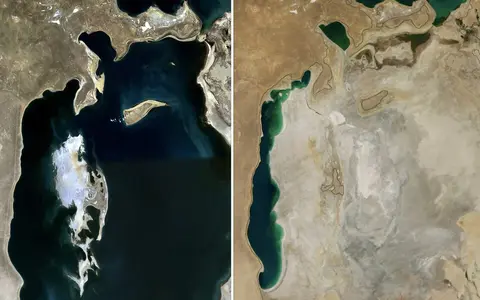
The name now spans unlike parts of the same depression. The North Aral, also called the Small Aral, lies in Kazakhstan behind the Kok-Aral dike. The former Large Aral to the south divided into a shallow eastern basin and a deeper western basin, chiefly in Uzbekistan. Satellite imagery from 18 March 2025 showed persistent ice-covered water in the North Aral, a much reduced western lobe, and a virtually dry eastern lobe.[5] A single undated “current area” would therefore be misleading.
A depression within the Turan Plain
The historical shoreline crossed what is now the Kazakhstan–Uzbekistan boundary; the political boundary identifies jurisdiction, not a natural division in the lake floor. The depression lies east of the Caspian Sea, beside the Ustyurt Plateau on the west. The Kyzylkum lies to the east and southeast, and the Karakum farther south. The Syr Darya approaches the northern depression from the east, while the Amu Darya delta spreads across its southern margin.[3]
This lowland setting is only the receiving end of a much larger drainage system. The Syr Darya carries snow- and glacier-fed runoff from the western Tien Shan; the Amu Darya carries it from the Pamir and northern Hindu Kush. Some water travels more than 2,000 km from mountain catchments to the lake, so the Aral water budget is controlled more by distant upland precipitation and water use along the rivers than by rainfall over the shoreline itself.[3]
An old depression with a younger lake record
Geological history and lake history are not the same. The structural depression occupies a Pliocene graben—a down-dropped crustal block bounded by faults—but the preserved lake sediments are much younger. A dated core from the eastern Large Aral records lake deposition back to about 17,600 calibrated years before present. The authors treat that as a minimum history at the core site, while reviewing older age estimates that differ with core location and dating method.[3]
The lake has not held a fixed natural level through that history. Sediment, fossil organisms, former shorelines, and archaeological sites record repeated transgressions (rising water) and regressions (falling water), driven by climate and by changes in the courses of the feeder rivers. The modern decline is exceptional in speed and cause, but low stands themselves are not geologically unprecedented. This distinction avoids treating the 1960 outline as the permanent natural boundary of the feature. [3]
Broad shelves, thresholds, and a western trench
A 1960 morphometric reconstruction gives a water surface of about 67,000 km², volume of 1,083 km³, level near +53 m above sea level, average depth of 16 m, and maximum depth of 69 m; the deepest floor was about 13 m below sea level near the western margin.[4] NASA gives corresponding plan dimensions of nearly 435 km north–south and just over 290 km at the widest point. [6] These are historical whole-lake measurements, not modern-remnant dimensions.
Much of the eastern and northern floor is shallow, so modest falls in level expose wide horizontal areas. Topographic sills then disconnect sub-basins: the northern and eastern floors lie near +23 to +24 m, while the western basin descends to roughly 11 m below sea level.[4] This relief explains why the eastern lobe can disappear while a narrow western strip persists and why retreat shifts river mouths across newly dry delta surfaces.
Small or North Aral
A shallow Syr Darya-fed basin retained behind the Kok-Aral dike in Kazakhstan.
Western Large Aral
The deepest remnant follows the trench beside the Ustyurt margin, but its width and length continue to vary.
Eastern basin and Aralkum
A broad, shallow floor that now alternates between residual water and exposed saline sediment.
A water balance dominated by rivers and evaporation
FAO's reconstruction of the pre-1960 mean balance estimates 47–50 km³ of river inflow each year, 5–6 km³ of groundwater inflow, and 5.5–6.5 km³ of direct precipitation over the lake. Together these approximately balanced about 60 km³ per year of evaporation.[7] The values are multi-year estimates for the former large surface, not measurements that can be transferred to the much smaller modern remnants.
Large irrigation withdrawals expanded during the twentieth century, reducing terminal river flow and breaking that balance. As water evaporates, dissolved salts remain; decreasing volume therefore raised salinity and separated waters that now have different chemistries. The Syr Darya reaches the North Aral, whereas Amu Darya water may spread through delta lakes and channels before any remainder reaches the southern depression. “Aral Sea salinity” is consequently no longer one basin-wide value. [4][7]
Dammed recovery in the north, continuing retreat in the south
By the end of the 1980s, the historical lake had divided into a Small Aral in the north and a Large Aral in the south; by 2000 the Large Aral had split into western and eastern lobes. The Kok-Aral dike, completed in 2005, retains Syr Darya water in the North Aral. ESA reports that mean northern water level subsequently rose by about 4 m.[5] This is a partial hydrological separation, not restoration of the former whole lake.
Kazakhstan's Ministry of Water Resources reported 23.40 billion m³ (23.40 km³) in the North Aral on 10 August 2026, up from 18.9 km³ in 2022.[8] The release does not state a survey method or uncertainty, so this page treats the figure as a dated official operational estimate, not a directly comparable replacement for the 1960 whole-lake volume. South of the dike, 2025 Sentinel-2 imagery showed continuing contraction of the western water and a virtually dry eastern basin. [5]
Distant snow, local aridity, and an exposed sediment plain
The receiving basin has a strongly continental climate: hot summers, cold winters, and little local precipitation. Across the wider watershed, however, precipitation rises from less than 50 mm per year in the dry northwest to more than 1,000 mm in the southeastern mountains. Westerly air supplies much of that upland moisture, with a primary precipitation season in spring and early summer and a secondary winter peak.[3] Snow and glacier melt then transfer it toward the lowland through the two long river systems.
As the shoreline retreats, waves no longer cover or rework former bottom sediment. Fine deltaic clay and silt, sand, evaporite salts, and saline mineral precipitates become exposed; wind can then deflate and redistribute the dry material. NASA's 7 October 2019 MODIS image records the former bed as light-toned mineral and dust surfaces, while ESA's 2025 image shows the much larger Aralkum pattern around the remaining water.[5][6] The Aralkum is therefore part of the modern physical feature, but it should not be confused with the older Kyzylkum or Karakum deserts beside it.
Sources and measurement notes
- United Kingdom Permanent Committee on Geographical Names, Kazakhstan: Toponymic Factfile, p. 6 (October 2022; accessed 29 August 2026). Source for the English conventional name, Kazakh Aral tengizi, Kazakhstan–Uzbekistan attribution, feature type, and 45°00′N, 60°00′E map reference. The factfile does not call that point a centroid.
- United Kingdom Permanent Committee on Geographical Names, Uzbekistan: Toponymic Factfile, p. 6 (January 2023; accessed 29 August 2026). Source for the Uzbek form Orol dengizi, the same international attribution and map reference, and the note that the feature is now mostly desert.
- Burr, G. S. et al., “A history of the modern Aral Sea (Central Asia) since the Late Pleistocene”, Quaternary Science Reviews 206, 141–149 (2019). Source for physical setting, distant mountain-fed runoff, Pliocene graben context, the dated 17.6-thousand-calibrated-year core record, past level variability, and continental-climate controls. The age is evidence from one core sequence, not a precisely dated creation event for the entire depression.
- Sala, R., “Quantitative Evaluation of the Impact on Aral Sea Levels by Anthropogenic Water Withdrawal and Syr Darya Course Diversion During the Medieval Period (1.0–0.8 ka BP)”, in Socio-Environmental Dynamics along the Historical Silk Road (Springer, 2019). Source for the 1960 morphometry and water-level estimate, published sub-basin floor and sill elevations, split-basin terminology, and the different hydrological trajectories of the north, east, and west waters. Elevations are published as metres above sea level without a named vertical datum.
- European Space Agency, “Earth from Space: The shrinking Aral Sea” (Sentinel-2 image acquired 18 March 2025; published 4 April 2025; accessed 29 August 2026). Source for the dated distribution of remnant water, the split chronology, Kok-Aral dike purpose and 2005 completion, reported 4 m mean northern rise, and exposed Aralkum surface. Image interpretation is a dated snapshot, not a fixed modern shoreline.
- NASA Goddard Space Flight Center, MODIS, “The Aral Sea” (Aqua MODIS image acquired 7 October 2019; published 11 October 2019; accessed 29 August 2026). Source for former plan dimensions, historical mean and maximum depths, and the satellite identification of saline mineral precipitate and dust on the exposed bed.
- Food and Agriculture Organization of the United Nations, Irrigation in the Countries of the Former Soviet Union in Figures, Water Reports 15, “Water resources of the Aral Sea basin” (1997; accessed 29 August 2026). Source for the Turan Plain depression, reconstructed pre-1960 river, groundwater, precipitation, and evaporation balance, and the growth of irrigation withdrawals. Its approximately 66,000 km² and 1,060 km³ figures are rounded multi-year summaries; this page uses Sala's explicitly dated 1960 reconstruction in the stat card.
- Ministry of Water Resources and Irrigation of the Republic of Kazakhstan, “Northern Aral: recovery dynamics” (data through 10 August 2026; accessed 29 August 2026). Source only for the dated North Aral volume series, including 18.9 km³ in 2022 and 23.40 km³ on 10 August 2026. The release provides no survey method, uncertainty, or whole-Aral total.