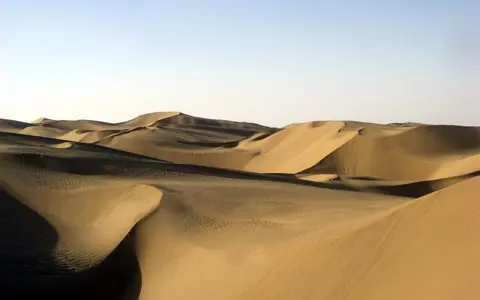

Desert, basin, and administrative region
Taklamakan is the spelling used for this atlas title, while scientific publications commonly use Taklimakan. The Library of Congress subject authority uses Takla Makan Desert (China) and lists both other forms as references to it; a Library of Congress romanization guide gives Taklimakan Shamo as the native GNS form.[14] These are naming variants of the same physical feature, not three deserts. The page covers the central sand sea and its immediate river and fan transitions.
The desert is not synonymous with the Tarim Basin. A hydrological study gives the wider drainage basin an area of about 1 million km², roughly three times the conventional 337,600 km² desert estimate.[4] The basin includes mountain catchments, irrigated oases, piedmont fans, river corridors, the lower Tarim and terminal lowlands that are outside the dune sea. Xinjiang is the administrative region containing both; its borders do not define the desert edge.
Published dimensions give useful scale but not a reproducible polygon. On the ground, the outer dunes grade into gravel surfaces, active and abandoned channels, alluvial fans and oasis belts. This page therefore retains 337,600 km² as a reference estimate rather than implying precision to the nearest square kilometre.[1]
A low basin floor inside a high mountain frame
The Taklamakan occupies the central Tarim depression below about 1,500 m, whereas much of the adjoining Tian Shan and Pamir barrier exceeds 3,000 m.[9] Tazhong, deep in the dune field, is at 1,109 m above mean sea level.[1] These figures describe elevation, not dune height: a 150 m dune is measured from its surrounding interdune surface and still stands on the elevated basin floor.
The frame is asymmetric. The Tian Shan borders the basin on the north; the Pamir closes its western end; the Kunlun and Altun ranges rise along the south and southeast; and the terrain opens toward the Lop Nur lowland in the east.[1] Giant alluvial fans spread from the active mountain fronts. Their coarse gravel remains near the ranges, while rivers carry sand and silt farther onto the basin floor, where wind can sort and remobilize it.[10]
Compound dunes, interdunes, and an interior ridge
The sand sea is not a field of identical ridges. Work in the northeast distinguishes compound or complex crescent dunes and crescent chains, compound dome dunes, and compound or complex linear dunes, with simpler dunes superimposed or scattered among them.[5] “Compound” means smaller dunes ride on a larger bedform; “complex” means dune forms or orientations from more than one wind regime occur together.
A 2025 study used a 30 m digital elevation model, satellite mapping, field surveys and centimetre-scale drone surface models to examine the eastern mega-dune tract. It mapped about 240 mega-dunes higher than 150 m relative to adjacent interdunes. Across its eastern study area, most mapped mega-dune heights fell between 20 and 80 m, with a 49 m mean; the tallest group lay east of the desert centre.[6] These are regional terrain measurements, not a maximum height for every Taklamakan dune.
Bedrock also interrupts the sand. The Mazar Tagh ridge crosses part of the western desert between the Hotan and Yarkand corridors. A wind-regime, sediment and flow-model study found different dune forms and orientations on its two sides and estimated that the ridge blocked 62.1% of the study's north-to-south sand supply.[7] The result shows why basin-floor obstacles matter; it is not a desert-wide sand-budget percentage.
Fans supply sediment
Short, steep catchments deliver mixed debris; channels and wind move the finer fractions farther into the basin.
Nested dune scales
Simple dunes may ride on much larger compound ridges, so “dune height” depends on which order of bedform is measured.
Not uniformly dry hollows
Low corridors may expose sand, silt, gravel, salt-rich sediment, or temporary river and flood deposits.
Mountain erosion, river delivery, wind reworking
A 39-sample provenance study compared dune sand with river sediment using detrital-zircon ages, heavy minerals and bulk petrography. Taklamakan sand most closely resembled material carried from the Kunlun Shan and Pamir, and differed from Tian Shan sources.[3] This does not mean the northern mountains supply no local sediment; it identifies the strongest compositional signal in that dataset.
The same work found two opposing transport systems. Rivers carry mountain debris northward from the Kunlun and then eastward along the Tarim corridor, while net aeolian transport is from northeast toward south. Major river signatures can persist across the sand sea, smaller Kunlun streams end within it, and wind repeatedly mixes river and lake deposits into dunes.[3] The Taklamakan is therefore a sediment-routing system, not simply weathered sand produced in place.
Its start date remains unsettled because studies test different deposits and different parts of the evolving basin. A southern-margin section showed that shifting dunes existed by at least 5.3 million years ago.[8] Radioisotopically dated tuff associated with aeolian deposits led another team to propose initial desertification between about 26.7 and 22.6 million years ago.[10] A later northwestern-basin study instead placed the first local erg near 12.2 million years ago and linked it to growth of the southern Tian Shan–Pamir moisture barrier.[9] These results may record spatially uneven aridification rather than a single moment when the modern dune field appeared everywhere.
Rivers cross the desert, but none reaches the sea
The Tarim system is endorheic: its water remains within the continental basin. In recent hydrological conditions, the Aksu, Yarkand and Hotan are the three mountain rivers with natural hydraulic connections to the Tarim main stem.[4] The Aksu approaches from the Tian Shan side; the Yarkand drains the western highlands; and the Hotan, formed from Kunlun-fed branches, flows north across the sand sea. The main Tarim then runs eastward along the desert's northern side.
Flow is strongly seasonal and loses water to channel beds, groundwater, irrigation and evaporation. The Hotan and Yarkand can carry sediment across the dune field during high flow, while smaller Kunlun rivers commonly terminate within the sand sea.[3] The Keriya is one example: its upper-basin record for 1958–2013 placed 66.4% of annual runoff in summer; north of Misalai its channel is ephemeral and carries floodwater onward to the interior Daliyabui oasis only during high-flow periods.[11]
The lower Tarim is not a permanently flowing outlet. Its terminal is Taitema Lake, southeast of the main dune field, but observations during ecological water-conveyance operations found that river water failed to reach the lake in 2006, 2007 and 2009.[12] Older dry channels, lake beds and saline depressions record changing terminal routes. The earlier page's grouping of the Qarqan with Tarim tributaries obscured this network: modern hydraulic-connection studies identify Aksu, Yarkand and Hotan instead.[4]
Continental distance, rain shadow, and rare storms
The Taklamakan is a hyper-arid, cold-winter continental desert. Its position deep within Eurasia limits oceanic moisture, while the Pamir and Tian Shan impede westerly flow and the Kunlun–Tibetan Plateau margin restricts moisture from the south. Geological evidence suggests that the northwestern rain shadow strengthened as the southern Tian Shan and Pamir rose during the Miocene.[9] No single range or air stream explains the whole desert.
Station data show why a desert-wide rainfall number is misleading. Across the Tarim Basin, the 1961–2021 mean was 66.2 mm/year, with a gradient from roughly 400 mm in mountain sectors to less than 10 mm in parts of the desert. Tazhong's 1999–2021 mean was 26.7 mm/year.[2] The basin became warmer and wetter over the multi-decadal record, and heavy-rain events increased after 2000, but greater variability and occasional storms do not make the long-term interior climate humid.
Summer heating produces an unusually deep convective boundary layer above the bare sand. During a July 2016 field campaign, Tazhong soundings placed the monthly mean afternoon boundary-layer height near 3,300 m above ground; it reached 5,000 m on one observed day.[1] This deep mixing helps couple surface heat and dust to regional circulation.
Mostly contained, sometimes exported
Near-surface easterly and northeasterly winds enter through the lower eastern side of the basin and organize much of the net sand transport. Wind regime, sand availability and local obstacles together determine dune orientation; a moving surface ripple should not be confused with wholesale migration of a compound mega-dune.
Satellite and reanalysis work for 2006–2012 found high spring and summer dust loading and linked strong events to enhanced easterly flow over the Tarim Basin. Most aerosol concentration declined sharply with height, yet particular synoptic conditions could loft dust to about 10 km, where westerlies carried it east along the Hexi Corridor or south toward the Tibetan Plateau.[13] The mountain rim therefore traps much dust at low levels without making the basin atmospherically sealed.
A sand sea distinct from neighboring drylands
Within the Desert Hub, the Taklamakan is a coherent sand sea inside one endorheic basin. That differs from the Gobi Desert, a much broader mosaic of plateaus, separate basins, gravel plains and local dune tracts east of the Tarim Basin. Studies calling the Taklamakan the world's second-largest shifting-sand desert after the Rub' al Khali are comparing mobile sand seas, not all climatological deserts.[6]
The surrounding relief also connects this record to the Karakoram, part of the high western and southwestern sediment-source region. The mountain system, river catchment and dune sea are physically linked but remain different geographic units.
Sources and measurement notes
- Wang, M. et al., “Features of the Deep Atmospheric Boundary Layer Over the Taklimakan Desert in the Summertime and Its Influence on Regional Circulation”, Journal of Geophysical Research: Atmospheres 124 (2019). Source for the 337,600 km² literature estimate, 1,070 × 410 km dimensions, mountain and Lop Nur setting, Tazhong coordinates and 1,109.0 m station elevation, and July 2016 sounding results. The paper does not publish a surveyed desert polygon.
- Li, M. & Yao, J., “Precipitation Extremes Observed Over and Around the Taklimakan Desert, China”, PeerJ 11, e15256 (2023). Uses China Meteorological Administration station data; source for the 1961–2021 Tarim Basin mean and spatial gradient, Tazhong's 26.7 mm/year mean for 1999–2021, and observed precipitation change.
- Rittner, M. et al., “The Provenance of Taklamakan Desert Sand”, Earth and Planetary Science Letters 437, 127–137 (2016). Thirty-nine aeolian and fluvial samples analyzed by detrital-zircon U–Pb geochronology, heavy minerals and petrography; source for Kunlun–Pamir provenance, river and wind transport directions, and seasonal sediment routing.
- Wang, X., Luo, Y., Sun, L. & Shafeeque, M., “Different Climate Factors Contributing for Runoff Increases in the High Glacierized Tributaries of Tarim River Basin, China”, Journal of Hydrology: Regional Studies 36, 100845 (2021). Source for the roughly 1-million-km² endorheic drainage-basin scope and the recent natural hydraulic connections of the Aksu, Yarkand and Hotan rivers.
- Wang, X., Dong, Z., Zhang, J. & Liu, L., “Geomorphology of Sand Dunes in the Northeast Taklimakan Desert”, Geomorphology 42, 183–195 (2002). Source for the northeast desert's compound and complex crescent, dome and linear dune forms and their wind-regime interpretation.
- Li, H. et al., “Geomorphology of Mega-Dunes in the Eastern Taklimakan Desert”, Journal of Geographical Sciences 35, 1329–1350 (2025). Source for the mobile-sand comparison class, eastern-dune spatial pattern, approximately 240 dunes above 150 m, 20–80 m principal height range, 49 m mean and the DEM, field and UAV methods.
- Hu, Z., Gao, X., Zhao, Y. & Lei, J., “Effect of the Mazar Tagh Mountains on Aeolian Landforms in the Western Taklamakan Desert, Northwestern China”, Geomorphology 418, 108464 (2022). Source for the ridge's local effects on wind, dune orientation and modeled north-to-south sand supply.
- Sun, J. & Liu, T., “The Age of the Taklimakan Desert”, Science 312, 1621 (2006). Source for the 1,626 m southern-margin stratigraphic section and evidence of shifting dunes by at least 5.3 Ma.
- Richter, F. et al., “Growth of the Southern Tian Shan–Pamir and Its Impact on Central Asian Climate”, Geological Society of America Bulletin 135, 1859–1878 (2023). Source for the basin–mountain elevation contrast, restriction of westerly moisture and approximately 12.2 Ma northwestern Tarim erg evidence.
- Zheng, H. et al., “Late Oligocene–Early Miocene Birth of the Taklimakan Desert”, Proceedings of the National Academy of Sciences 112, 7662–7667 (2015). Source for the dated volcanic tuff, 26.7–22.6 Ma interpretation, giant marginal fans and tectonic–climatic formation model.
- Li, Y. et al., “Influence of Natural and Anthropogenic Controls on Runoff in the Keriya River, Central Tarim Basin, China”, PLOS ONE 17, e0269132 (2022). Source for the Keriya's approximately 740 km course, 1958–2013 upper-basin seasonal runoff shares and modern ephemeral lower reach.
- Chen, Y., Chen, Y., Zhu, C., Wang, Y. & Hao, X., “Ecohydrological Effects of Water Conveyance in a Disconnected River in an Arid Inland River Basin”, Scientific Reports 12, 9982 (2022). Source for Taitema Lake as the modern Tarim terminal and the documented intermittency of water reaching it during 2000–2020 conveyance operations.
- Ge, J. M. et al., “Characteristics of Taklimakan Dust Emission and Distribution: A Satellite and Reanalysis Field Perspective”, Journal of Geophysical Research: Atmospheres 119, 11,772–11,783 (2014). Uses 12 years of MISR and six years of CALIOP observations with reanalysis; source for seasonal dust structure, enhanced easterly flow and occasional lofting to 10 km.
- Library of Congress, “Takla Makan Desert (China)”, Library of Congress Subject Headings, 35th ed., section T (2013), and “Chinese Place Names” romanization guidance (2007). Sources for the Takla Makan, Taklamakan and Taklimakan name relationship and the GNS conventional and native forms.