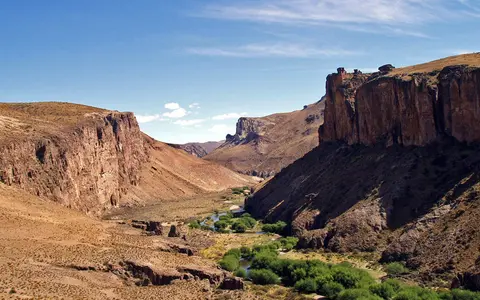

Desert, steppe, and Patagonia are not identical
“Patagonian Desert” is a broad geographic label. Scientific and Argentine official sources more often map the Patagonian Steppe, a vegetation and biogeographic region containing grass steppe, shrub steppe, and semidesert. This page uses the familiar desert name but follows that physical steppe system; it does not include all Patagonia, which also contains Andean forest, icefields, high mountains, wetlands, and Pacific archipelagos.
No surveyed polygon fixes one desert area. The Argentine National Parks ecoregion exceeds 542,000 km², from the Payunia volcanic fields in southeastern Mendoza to northern Tierra del Fuego and from the Andes toward the Atlantic.[1] A broader IUCN grassland frame spans 39–55°S and more than 800,000 km² in Argentina and Chile, but explicitly includes environments ranging from semidesert to humid prairie.[2] These figures measure different classifications and must not be treated as competing estimates of the same boundary.
Even biogeographic boundaries depend on criteria. A 2018 Patagonian Steppe shapefile was based mainly on a 1:5,000,000 vegetation map, augmented with Chilean distribution data and ecotones; it separates Payunia, Western, Central, Sub-Andean, and Austral subprovinces.[3] To the north and northeast, the Monte of Plains and Plateaus is a separately mapped Argentine ecoregion that bends toward the Atlantic through Río Negro and Chubut. Calling that entire northern dry belt Patagonian Desert erases a real regional boundary.[4]
From the Andean lee to the South Atlantic
The main expanse lies in Argentine extra-Andean Patagonia. The Argentine climate atlas distinguishes this meseta country from the narrow mountainous Patagonian Andes: stepped plateaus, isolated low ranges, broad depressions or bajos, and wide valleys occupy the interval between the range and the Argentine Sea. Rivers commonly run west to east, and coastal plateaus end locally in cliffs exceeding 200 m.[5]
Across the international border, steppe is much less extensive. It occurs in eastern rain-shadow pockets of Chile's Aysén and Magallanes regions and across the dry north-central part of Tierra del Fuego. A 2024 photo-interpretation and ASTER-elevation study estimated about 26,997 km² of Chilean Patagonian steppe, but that method and national scope differ from Argentina's ecoregion mapping, so the two areas are not combined here.[6]
Andean rain-shadow edge
Forest–steppe transitions and dry intermontane valleys track sharp changes in elevation and moisture.
Mesetas and bajos
Plateau rims, structural benches, volcanic caps, enclosed depressions, and cañadones break up the apparent plain.
Atlantic valleys and cliffs
Major rivers cross the dryland to estuaries, while plateaus and marine terraces reach an indented coast.
Why the plains form a staircase
The Patagonian surface is not one uniform gravel sheet. Sedimentary basins, older crystalline massifs, volcanic rocks, fluvial gravels, marine deposits, and wind-worked sediment appear in different districts. Erosion cuts the plateau edges into bardas (escarpments) and cañadones (steep-sided valleys, often dry), while broad river valleys and enclosed lows interrupt the higher surfaces.
In central extra-Andean Patagonia, some mesetas now exceed 1,000 m because of relief inversion: lava or resistant gravel protected former valley floors while erosion lowered the less resistant ground around them. SEGEMAR attributes much of this inversion to the last four or five million years; today's high tablelands can therefore preserve the position of ancient low corridors rather than mark former mountain crests.[7]
Basalt is important but not universal. A GIS inventory in Santa Cruz links individual basaltic plateaus to separate Cenozoic eruptive episodes. Older flows have been raised tens to hundreds of metres relative to surrounding terrain by erosion, and springs commonly emerge where permeable lava meets underlying rock; those outlets can support wet mallines below otherwise dry slopes.[8] The desert is therefore a mosaic of rock-controlled surfaces, not simply a wind-built landform.
No single date for desertification
Andean uplift established the major west–east barrier, but it did not create the modern steppe in one event. Fossil pollen from eastern Patagonian marine deposits dated to roughly 10–6 million years ago indicates a mesothermal landscape with reconstructed annual precipitation rarely below 661 mm, compared with about 200 mm in the authors' modern Patagonian reference. Their result shows that major drying continued after important phases of Andean uplift and was not caused by uplift alone.[9]
Later cooling, changes in Southern Hemisphere circulation, volcanic burial, river incision, repeated glaciations near the Andes, and Quaternary erosion all modified different parts of the foreland. At about 46°30′S, dated moraines, outwash, and Río Deseado terraces record at least five major pre-Marine-Isotope-Stage-8 ice advances; mapped terrace ages span about 1.167 million to 447,000 years.[16] Glacial meltwater and sediment helped build some east-trending valley and terrace systems; basalt protected other surfaces; wind removed and redistributed fine material. “The desert formed 12–15 million years ago” is therefore too simple: that interval describes part of the mountain and climate transition, not the birth date of every modern surface or steppe district.
Atlantic rivers, closed basins, and dry cañadones
The dryland is divided among many drainage systems, not contained in one basin. Argentina's national basin map distinguishes exorheic catchments that reach the sea, endorheic catchments that terminate in a lake or salar, and arreic areas where water infiltrates or evaporates before a connected channel network forms.[10] All three conditions occur across Patagonia.
The Río Chubut illustrates an allochthonous through-river—one sustained by water generated outside the driest terrain. It rises at Cerro Carreras, turns east from the Andean margin, becomes allochthonous across the meseta, and receives mainly intermittent side channels before reaching the Atlantic at Bahía Engaño.[11] Farther south, the Río Santa Cruz begins at the east side of glacier-fed Lago Argentino and runs about 383 km across Santa Cruz to the Atlantic; its national basin sheet records a mean channel gradient of 0.53 m per kilometre.[12]
By contrast, the Senguerr runs about 340 km from the Andean–pre-Andean headwaters to lakes Musters and Colhué Huapi. The national basin sheet describes this lake system as normally endorheic: only exceptional upper-basin floods send surplus water onward through the Río Chico toward the Río Chubut.[13] That switching connection, together with rainfall-fed cañadones and dry enclosed lows, explains why “ephemeral drainage” cannot describe every Patagonian river.
Westerlies lose moisture at the Andes
South of about 35°S, weather systems embedded in the prevailing westerlies deliver moisture from the Pacific. Air is forced upward over the Andes, where cooling promotes precipitation; on the eastern slope it descends, warms, and dries. An observational study using surface gauges and CloudSat and MODIS data for 2006–2016 found precipitation and cloud frequency strongly reduced east of the Patagonian Andes, with lee-side values about three to four times lower than their upstream and upslope counterparts.[14]
Cold steppe, coded BSk in the Köppen system, is the dominant mapped class across much of Argentine extra-Andean Patagonia, but the page boundary is not a Köppen contour. The SMN's 1991–2020 atlas also shows a marked west–east gradient and predominantly westerly winds at Bariloche, Comodoro Rivadavia, and Río Gallegos in its 2011–2020 wind roses.[5] Regional compilations give 150–500 mm of mean annual precipitation and 0–12°C mean annual temperature across the much broader Patagonian steppes; the wide ranges reflect latitude, elevation, coast–interior position, and inclusion of wetter grass-steppe margins.[2]
Wind is both a climate control and a geomorphic agent. It raises dust from exposed fine sediment and carries it east. On 20 February 2016, for example, SMN lidar and satellite observations tracked a dust plume from southern Argentine Patagonia to the Atlantic near Comodoro Rivadavia (45°47′31″S, 67°27′46″W).[15] This documented event supports eastward dust transport without implying that every stony plateau is wind-built.
Dry surfaces still change abruptly
Low annual precipitation does not mean runoff is absent. Short storms activate cañadones and alluvial fans; snow and ice melt sustain selected through-rivers; exceptional floods can reconnect normally closed systems such as Senguerr–Colhué Huapi–Río Chico. The resulting erosion and deposition are concentrated in brief pulses separated by long dry intervals.
Water is also redistributed by geology. Springs at basalt contacts feed localized mallines, river valleys carry perennial water across dry tablelands, and enclosed lows collect sediment and salts. These wet corridors and patches belong to the physical geography of the dryland; their presence does not contradict the regional aridity, but shows how strongly relief, substrate, and distant headwaters control water availability.
A cold dryland, not a sand-sea analogue
The Patagonian Desert belongs in the Desert Hub because water deficit governs much of its surface, but “steppe” is usually the more exact landscape term. Its identity rests on a cross-section from the Andes through forest–steppe transitions, mesetas and basins to Atlantic valleys and cliffs—not on a single dune field, drainage basin, administrative province, or exact desert polygon.
Sources and measurement notes
- Administración de Parques Nacionales, Argentina, “Estepa Patagónica” (accessed 29 August 2026). Source for the Argentine ecoregion's more-than-54.2-million-hectare area and its Payunia-to-northern-Tierra-del-Fuego, Andes-to-Atlantic description; hectares are converted here at 100 ha = 1 km².
- Michelson, A., “Patagonian Steppes (Argentina and Chile)”, in Life in a Working Landscape: Regional Templates on the Status of Temperate Grasslands Conservation and Protection, pp. 172–176 (IUCN regional workshop compilation, 2008). Source for the broader 39–55°S and more-than-800,000-km² frame and the compiled 150–500 mm precipitation and 0–12°C temperature ranges; this scope includes humid prairie as well as semidesert.
- Roig-Juñent, S. A. et al., “The Patagonian Steppe biogeographic province: Andean region or South American transition zone?”, Zoologica Scripta 47, 623–629 (2018). Source for the vegetation-based 1:5,000,000 boundary, Chilean additions, ecotones, and named subprovinces.
- Administración de Parques Nacionales, Argentina, “Monte de Llanuras y Mesetas” (accessed 29 August 2026). Used to distinguish the separately mapped Monte ecoregion along the northern and northeastern transition.
- Servicio Meteorológico Nacional, Atlas Climático de Argentina: Período 1991–2020, 2024 edition, 129 pp., ISBN 978-987-22663-5-6. Source for the Argentine extra-Andean landform summary, west–east river orientation, coastal-cliff context, Köppen mapping, precipitation climatology, and 2011–2020 wind roses.
- Radic-Schilling, S. et al., “Steppe Ecosystems in Chilean Patagonia: Distribution, Climate, Biodiversity, and Threats to Their Sustainable Management”, in Conservation in Chilean Patagonia, pp. 175–202 (2024). Source for the restricted Chilean distribution and approximately 26,996.9 km² photo-interpreted estimate using high-resolution imagery and ASTER GDEM; the value is rounded in the prose.
- Simeoni, A., “Mesetas y Bajos de la Patagonia Central Extraandina: La inversión del relieve”, in SEGEMAR, Sitios de Interés Geológico de la República Argentina, Anales 46, vol. II (2008). Source for relief inversion, its four-to-five-million-year context, and central mesetas exceeding 1,000 m.
- Mazzoni, E. & Rabassa, J., “Inventory and classification of basaltic occurrences of Patagonia based on satellite images and G.I.S., province of Santa Cruz”, Revista de la Asociación Geológica Argentina 66(4), 608–618 (2010). Source for Cenozoic basaltic episodes, erosional relief inversion, and springs and mallines at lava contacts in Santa Cruz.
- Palazzesi, L. et al., “Fossil pollen records indicate that Patagonian desertification was not solely a consequence of Andean uplift”, Nature Communications 5, 3558 (2014). Source for the 10–6 Ma pollen reconstruction, stated modern comparison, and the qualified desertification history.
- Secretaría de Obras Públicas, Argentina, “Mapa de Cuencas Hidrográficas de la República Argentina” (accessed 29 August 2026). Source for the national exorheic, endorheic, and arreic drainage definitions and basin-system framework.
- Subsecretaría de Recursos Hídricos, Argentina, Cuenca del Río Chubut, basin sheet 65 (accessed 29 August 2026). Source for the river's headwaters, eastward course, allochthonous middle reach, intermittent plateau tributaries, and Atlantic outlet; older demographic material in the sheet is not used.
- Subsecretaría de Recursos Hídricos, Argentina, Cuenca del Río Santa Cruz, basin sheet 70 (accessed 29 August 2026). Source for Lago Argentino as the river's origin, its approximately 383-km lake-to-estuary course, 0.53 m/km mean gradient, and glacier-fed upper system; dated discharge tables are not presented as current values.
- Subsecretaría de Recursos Hídricos, Argentina, Cuenca de los Ríos Senguerr y Chico, basin sheet 66 (accessed 29 August 2026). Source for the approximately 340-km Senguerr course and the normally endorheic Musters–Colhué Huapi system's exceptional flood connection to the Río Chubut.
- Viale, M. & Garreaud, R., “Contrasting Climates at Both Sides of the Andes in Argentina and Chile”, Frontiers in Environmental Science 7, 69 (2019). Surface-station and satellite analysis for 2006–2016; source for the rain-shadow mechanism and three-to-fourfold lee-side reduction south of 35°S.
- Otero, L. A. et al., “Dust Plumes in Patagonia Argentina Detected by Comodoro Rivadavia Stations on February 20th, 2016”, Servicio Meteorológico Nacional and collaborators (2016). Source for the dated dust-transport example and monitoring-station coordinates.
- Tobal, J. E. et al., “Quaternary landscape evolution of Patagonia at the Chilean Triple Junction: Climate and tectonic forcings”, Quaternary Science Reviews 261, 106960 (2021). Source for the approximately 46°30′S study position, 28 cosmogenic 10Be exposure ages, multiple pre-MIS-8 glacial advances, outwash, and the 1.167–0.447 Ma Río Deseado terrace-age range.