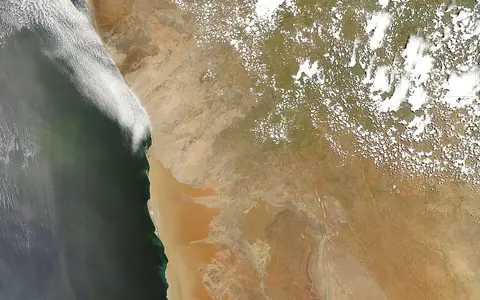

A physical region with graded edges
“Namib” names a desert region rather than one surveyed land parcel. Henschel and Lancaster's research frame places it between the Bentiaba River—identified there by the older name Rio São Nicolau, at 14°16′S, 12°22′E—and the Olifants River at 31°42′S, 18°11′E. They describe a belt more than 2,000 km long, 50–150 km wide, larger than 130,000 km², mostly below 1,000 m and between the 10- and 100-mm rainfall isohyets.[1] Those figures define a scientific regional treatment, not a cadastral boundary; ecological, climatic, and geomorphic maps place the transition somewhat differently.
The desert crosses international borders, with its long central reach in Namibia. Its eastern edge grades into escarpment and interior plateau terrain rather than following an administrative line. The Kalahari lies farther inland within a broad sand-covered basin and has a different moisture and drainage setting; it should not be used as a synonym for the Namib.
The Namib Sand Sea is narrower in meaning. It is the dune-dominated sector between the Lüderitz and Walvis Bay regions, whereas the wider Namib also includes northern gravel plains, the Skeleton Coast dune fields, rocky massifs, river corridors, and southern coastal surfaces. UNESCO records the Sand Sea property at 3,077,700 hectares (30,777 km²), with a listed reference coordinate of 24°53′07″S, 15°24′28″E. That coordinate identifies the mapped property's reference point, not the centre of the entire transboundary desert.[2]
Atlantic shore to interior escarpment
From west to east, the terrain commonly rises from beaches, rocky headlands, lagoons, salt flats, and low coastal plains into gravel or sand-covered surfaces. Inselbergs—isolated bedrock hills left standing above an eroded plain—and larger massifs interrupt the low relief. Farther inland, pediments and alluvial fans meet the foot of the Great Escarpment, the steep western rim of southern Africa's higher interior plateau.
The sequence is not uniform along 2,000 km of coast. South of the Kuiseb River, the Namib Sand Sea dominates a broad tract; north of the river near Gobabeb, ancient gravel plains are more prominent. UNESCO's mapped Sand Sea includes active and underlying semi-consolidated dunes together with gravel plains, coastal flats, inselbergs, playas, and ephemeral channels, confirming that even this dune-rich subregion is not continuous sand.[2]
Marine margin
Cold water, coastal upwelling, low cloud, beaches, lagoons, and salt-rich flats meet an exceptionally dry land surface.
Plains and dune fields
Gravel pavements, deflation surfaces, sand sheets, barchans, linear dunes, star dunes, and dry valleys vary by sector.
Escarpment transition
Fans, rock outcrops, and incised valleys rise toward highlands that supply runoff and sediment to the coastal desert.
How the main sand sea is supplied
The large southern dune field is an erg, or extensive area of wind-worked sand. Mineralogical and zircon-age evidence identifies the Orange River as the predominant ultimate source of the modern Namib Sand Sea's sand. The river carries material from southern Africa's interior to its Atlantic mouth; waves and northward longshore transport redistribute the sand along the coast; prevailing southerly winds then blow it inland and northward. Local rivers and recycled older deposits add material at the sand sea's margins, so the conveyor is dominant rather than exclusive.[6]
Wind direction and sediment availability produce different dune forms and rates of movement. Long linear ridges dominate much of the main sand sea, while barchans—crescent dunes formed where sand supply is limited and wind is strongly directional—occur in other coastal fields. A repeated-satellite analysis at 18.01°S, 11.88°E in the northern Namib measured several barchans moving 900–1,000 m northwest between 1996 and 2020, an average of 38–42 m a year.[5] That is a site-specific rate for relatively small mobile dunes, not a migration rate for every Namib dune.
At the Sand Sea's northern edge, the Kuiseb channel repeatedly removes dune sand arriving from the south and helps maintain the abrupt dune–gravel-plain boundary. Radar mapping south of the present river found an 8-km-wide corridor of buried palaeochannels, showing that river position and dune advance have shifted through the Holocene rather than remaining fixed.[8]
Perennial margins, episodic crossings, internal terminals
The Namib is crossed by west-flowing rivers whose headwaters lie on wetter uplands east of the desert. In Namibia, the Kunene and Orange are perennial border rivers, but intervening systems such as the Swakop and Kuiseb usually carry surface water only after rainfall in their upper catchments. Farther south, channels including the Tsauchab lose water to evaporation and infiltration and terminate among the dunes; the Tsauchab ends at Sossusvlei about 55 km short of the coast.[9]
The Kuiseb provides a measured example. A 2020 radar and field study reports a length of 560 km and a catchment larger than 15,000 km². It rises in the Khomas Hochland, crosses the Great Escarpment, and drains west toward Walvis Bay. Summer rainfall in the upper basin produces short floods, but transmission losses—the loss of channel water into porous sand and gravel—mean that most flows disappear before reaching the Atlantic. Infiltration from medium and large floods is an important source of recharge to the river's alluvial aquifer.[8]
Dry channels therefore remain active geographical structures between floods. They cut escarpment gorges, carry gravel and fine sediment onto the coastal plain, interrupt dune fields, and store groundwater within alluvium. A pan or vlei is a shallow closed depression where episodic water ponds and then evaporates or infiltrates; it is not evidence of a permanent lake or an integrated surface-drainage network.
Why a foggy coast receives little rain
Strong southerly winds drive surface water away from the coast through Ekman transport, allowing cold, nutrient-rich water to upwell within the Benguela Current system. The chilled sea surface cools moist air near the ocean. At the same time, descending air associated with the South Atlantic Anticyclone forms a warmer, drier layer above it. This temperature inversion suppresses deep convection: low stratus and fog can form, but rain-producing clouds seldom build.[3]
Rainfall and fog are measured differently and should not be combined into one precipitation total. The 2022 Atlas of Namibia maps average annual rainfall by July–June rainfall season and reports less than 20 mm a year within 40 km of the Namibian coast, with large year-to-year variability. Its satellite and ground synthesis finds fog or low cloud in every month, sometimes more than 100 km inland; the central coast has some fog on about one-third of days. Satellite sensors cannot always distinguish a low cloud deck from fog touching the ground, so that frequency is not a uniform station count across the desert.[4]
Conditions change rapidly inland. Fog frequency generally declines with distance and elevation, while summer convective rain becomes more influential toward Namibia's northern and eastern margins. Winter frontal rain is more important in the far south. These gradients explain why a cool, humid morning at the coast can coexist with almost rainless gravel plains and warmer escarpment-facing terrain within the same desert belt.
No single defensible “birth date”
The age of a sandstone, the residence time of a sand grain, the exposure age of a gravel surface, and the establishment of the modern Benguela circulation answer different questions. They cannot be collapsed into one date for the whole Namib. Beneath parts of the modern Sand Sea, semi-consolidated aeolian and river deposits record older dryland phases; the active dunes above them are repeatedly reworked.
A 2025 sediment-provenance synthesis reports that the Benguela Current began about 10–12 million years ago but did not always extend as far north as it does now, and that hyperaridity was not constant during the past 20 million years. Its cosmogenic-nuclide model places the most recent phase of widespread sand dispersal at about 2 million years ago and estimates roughly 1.5 million years of transport residence for marginal sands at the northern edge of the erg.[7] Those results concern modeled sediment histories within the Namib Sand Sea, not a universal age for the transboundary desert.
A linked ocean–desert–upland system
The Namib belongs in the Desert Hub as a coastal desert whose processes cross conventional boundaries. The Atlantic controls temperature, fog, and littoral sand transport; the interior plateau supplies river water and sediment; the Great Escarpment compresses those changes into a relatively short west–east distance.
For comparison, the Atacama Desert is another cold-current west-coast desert, but it occupies an active Andean forearc rather than southern Africa's passive continental margin. The Kalahari provides the inland contrast, while the Orange River record traces the main long-distance source of sand to the southern Namib dune system.
Sources and measurement notes
- Henschel, J. R. & Lancaster, N., “Gobabeb—50 years of Namib Desert research”, Journal of Arid Environments 93, 1–6 (2013). Source for the Bentiaba-to-Olifants research extent, endpoint coordinates, 50–150 km width, greater-than-130,000-km² regional area, below-1,000-m elevation context, and desert subdivisions. These are regional scientific limits, not an official boundary survey.
- UNESCO World Heritage Centre, “Namib Sand Sea”, World Heritage List property 1430, inscribed 2013 (record accessed 29 August 2026); see also UNESCO's geographical data and inscribed-property map. Source for the 3,077,700-ha property area, 899,500-ha buffer zone, reference coordinate, component landforms, and the distinction between the property and the larger Namib Desert.
- Atlas of Namibia Team, “Why is Namibia so dry?”, in Atlas of Namibia: Its Land, Water and Life, Namibia Nature Foundation (2022). Source for the Benguela Current, coastal upwelling, prevailing southerly winds, anticyclonic subsidence, and temperature-inversion mechanism.
- Atlas of Namibia Team, “Rainfall patterns” and “Fog”, in Atlas of Namibia: Its Land, Water and Life, Namibia Nature Foundation (2022). Source for the July–June rainfall-year method, less-than-20-mm coastal average within 40 km, fog reach and frequency, seasonality, and the satellite low-cloud qualification.
- Atlas of Namibia Team, “Prominent features”, in Atlas of Namibia: Its Land, Water and Life, Namibia Nature Foundation (2022). Source for Namib dune types, wind directions, Orange-derived sand, and the 1996–2020 barchan-movement measurement at 18.01°S, 11.88°E.
- Garzanti, E. et al., “Petrology of the Namib Sand Sea: Long-distance transport and compositional variability in the wind-displaced Orange Delta”, Earth-Science Reviews 112, 173–189 (2012). Source for the mineralogical and zircon-age evidence connecting Orange River sediment, northward littoral transport, inland wind transport, and subsidiary local sources.
- Caracciolo, L. et al., “Neogene sedimentary processes forming the Namib Sand Sea”, Earth-Science Reviews 271, 105247 (2025); open-access publication record. Source for changing fluvial–aeolian interactions, the 10–12 Ma Benguela initiation range, variable hyperaridity, and cosmogenic-nuclide model estimates. These results are not used as an age for the whole desert.
- Paillou, P., Lopez, S., Marais, E. & Scipal, K., “Mapping Paleohydrology of the Ephemeral Kuiseb River, Namibia, from Radar Remote Sensing”, Water 12, 1441 (2020). Source for Kuiseb length and catchment area, drainage direction, flood and aquifer-recharge setting, the dune–plain boundary, and the 2016–2019 radar, ground-penetrating-radar, and field mapping of the 8-km-wide palaeochannel corridor.
- Atlas of Namibia Team, “Perennial rivers” and “Ephemeral rivers”, in Atlas of Namibia: Its Land, Water and Life, Namibia Nature Foundation (2022). Source for the Kunene and Orange as perennial Atlantic rivers, westward ephemeral drainage, the Swakop, Kuiseb, and Tsauchab contrasts, Sossusvlei's approximately 55-km distance from the coast, and the rarity of Kuiseb floods reaching the sea.