
What the name covers
“Arabian Desert” is the accepted English regional name for the extensive arid terrain of Arabia. This record uses it for the connected desert interior of the peninsula and its low dry margins: chiefly Saudi Arabia, with continuities into Kuwait, Qatar, the United Arab Emirates, Oman, Yemen, and the Jordanian borderlands. It is not another name for the Rub' al Khali, or Empty Quarter, which is one southern sand sea within the wider region.
The scope is physical rather than political. The wetter and higher cores of the Asir–Yemen and Al Hajar mountains are boundary features, not automatically desert because they lie within peninsula states. At the north, rock and gravel plains merge gradually into the Syrian Desert; this atlas treats that northern dryland separately. Coastal fog belts and tidal flats likewise differ from the interior even where maps group them into a broader Arabian dryland.
There is therefore no defensible single coordinate, fixed outline, or timeless area for the whole feature. The former “about 2.3 million km²” card did not identify a mapped boundary and has been removed. Area figures for a biome, ecoregion, peninsula, or individual sand sea answer different questions and should not be substituted for one another.
From Red Sea uplands to Gulf lowlands
The main topographic gradient runs from the raised western and southwestern margin toward the north and east. Along the Red Sea, crystalline uplands and steep escarpments stand above the narrow Tihama coastal plain. Eastward, the surface crosses the Najd interior and successively younger sedimentary rocks before reaching low plains, inland depressions, and coastal sabkhas beside the Gulf.
Three large sand systems help orient the interior. An Nafud occupies northern Saudi Arabia. Ad-Dahna is a narrower, curving sand belt that links the northern dunes to the Rub' al Khali, which fills much of the south-central and southeastern interior across Saudi Arabia, Oman, the UAE, and Yemen. NASA gives about 660,000 km² for this sand sea, while a 2025 study uses about 640,000 km².[4][10] Both values are rounded and neither source defines a surveyed perimeter, so this page treats them as approximately 0.65 million km² rather than as contradictory precision.
Central Arabia is not a level expanse between those sands. The Najd contains cuestas—ridges made where gently tilted resistant beds are eroded into a steep face and a gentler backslope—and broad plateaus cut by wadis. Jabal Tuwayq is the clearest example: Saudi Arabia's National Center for Wildlife describes its limestone escarpment as about 1,000 km long, with its southern end meeting the western Rub' al Khali.[3]
An uplifted shield and a tilted platform
The western foundation is the Arabian Shield, a large exposure of Precambrian igneous and metamorphic basement. A U.S. Geological Survey synthesis maps about 670,000 km² of shield rock—roughly one-third of the peninsula—along the northeastern side of the Red Sea.[1] Weathering and short, steep drainage have cut pediments, rock plains, and mountain-front fans across this hard-rock province. Dark Cenozoic lava fields, called harrats, locally cover the shield and adjacent sedimentary terrain.
East of the shield, the Arabian Platform consists of a thick succession of younger sedimentary rocks. Beds generally dip away from the western upland toward the Gulf and Rub' al Khali basins; Jurassic limestone is prominently exposed along the Tuwayq escarpment.[2] Differential erosion of limestone, sandstone, shale, and evaporite-bearing units produces stepped escarpments, mesas, gravel surfaces, karst features, and low saline basins rather than one uniform “sand desert.”
The west-to-east asymmetry was strengthened when rifting separated Arabia from northeast Africa and opened the Red Sea and Gulf of Aden beginning about 25 million years ago. A geological synthesis places the rift-flank surface at roughly 2,000–3,000 m above sea level in parts of western Arabia, descending toward sea level around the Gulf; those are regional surface ranges, not a mean elevation for the desert.[5]
Shield, scarps, and harrats
Crystalline basement, volcanic fields, steep wadis, and rift-margin relief dominate the Red Sea side.
Plateaus and cuestas
Gently tilted sedimentary beds are cut into long escarpments and rock-floored drainage corridors.
Basins and sabkhas
Low-gradient surfaces collect windblown sand, fine sediment, shallow groundwater, and evaporated salts.
Why dune form changes across Arabia
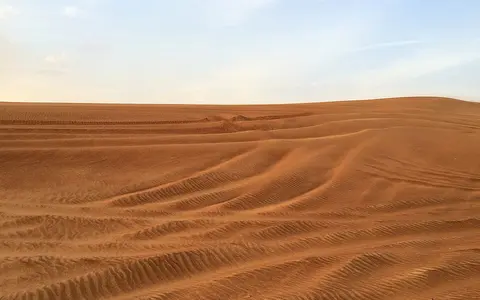
Sand availability and wind direction vary across the peninsula, so the ergs contain several dune families. NASA imagery of the Rub' al Khali shows long linear dunes alternating with interdune sabkhas, plus crescentic barchans and multi-armed star dunes where wind regimes interact. In that southeastern sector, northwesterly Shamal winds help organize the linear forms, while seasonal southwesterly winds can build secondary dunes across them.[4]
Dunes are sediment stores as well as moving landforms. Sand can be reworked from older river and lake deposits, weathered sandstone, coastal deposits, and exposed basin sediment. Gravel plains and rock plateaus interrupt the sand bodies, while alluvial fans introduce coarser material along escarpments and mountain fronts. The resulting pattern is a mosaic of aeolian, fluvial, and bedrock surfaces.
A sabkha is an evaporative salt flat, not simply a dry lake. It can form where saline groundwater lies near the surface in an inland depression or coastal plain. In the northeastern Rub' al Khali, a 2025 hydrogeochemical study found wet interdune sabkhas where groundwater is commonly less than 2 m below the surface; evaporation concentrates salts and precipitates gypsum and anhydrite.[10] That local measurement should not be generalized to every Arabian sabkha.
Wadis above, regional aquifers below
Modern drainage is episodic. Wadis are valleys or channels that may remain dry for long periods, then carry short-lived floods after intense rain. Wadi ar Rimah–al Batin, Wadi Hanifah–Sahba, Wadi ad Dawasir, and Wadi Najran drain parts of the shield and central escarpments toward the interior platform and its basin lows.[7] Runoff spreads across fans and floodplains, infiltrates channel sediment, or ends in playas and sabkhas; there is no peninsula-wide perennial river network.
Below the eastern platform, stacked sandstone and carbonate aquifers transmit water down the regional dip, broadly from southwest to northeast, toward springs, sabkhas, and the Gulf. For the Upper Mega Aquifer System—not the entire desert—modern recharge estimates range from about 0.5 to 20 mm per year, with a modeled regional mean of 2.2 mm per year. Isotope measurements indicate residence times up to about 20,000–30,000 years, so much of the stored water entered under wetter climates and is commonly described as fossil groundwater.[7]
Surface and groundwater are linked at wadis and limestone outcrops. Floodwater can bypass low-permeability beds through channel alluvium, while groundwater can feed springs or shallow saline flats. Saudi rainfall and water data should not be mistaken for a peninsula-wide hydrologic average: even within Saudi Arabia, observation grids and the sparse station network produce different national precipitation estimates.[8]
Hot-desert core, wetter mountain margins
Modern Köppen–Geiger maps place most of the interior in BWh, the hot-desert class, but the regional name extends across gradients that one climate code cannot capture. Steppe and cooler or wetter mountain climates interrupt the desert around the northern, western, southern, and Omani margins. The 1991–2020 classification is a gridded climatic product, not a legal or geomorphic boundary for the Arabian Desert.[6]
Persistent subtropical subsidence suppresses widespread rainfall, while extreme summer heating and high potential evaporation maintain the moisture deficit. A 9-km regional climate simulation for 1986–2015 found strong seasonal and spatial contrasts: Mediterranean weather systems influence the north, the Indian summer monsoon affects the south, and topography, sea breezes, Shamal flow, and dust modify conditions locally.[9]
Saudi Arabia provides a traceable example of the scale of that gradient. An analysis combining ERA5 reanalysis with Ministry of Environment, Water and Agriculture station data reports less than 100 mm of annual precipitation across most of the country, about 20 mm per year in the Empty Quarter, and up to about 500 mm in southern mountains. Its 1950–2021 ERA5 country mean was 65 mm per year; for 2010–2019, ERA5 gave 40–90 mm per year while the mainly urban station network gave 60–130 mm. The difference reflects coverage and method, so none of those figures is presented here as a timeless mean for the whole Arabian Desert.[8]
Flood records beneath the modern desert
Dry channels, lake beds, and buried alluvium show that present aridity is only one phase of the landscape. During repeated late-Quaternary humid intervals, monsoon rain belts extended farther into Arabia, lakes occupied interior depressions, and larger river systems carried water and sediment from the western highlands toward the Rub' al Khali and Gulf side.
A 2025 study in the northeastern Rub' al Khali reconstructed a roughly 1,100-km² depression that filled during the Holocene Humid Period or an earlier wet interval, then breached to help cut an outlet valley about 150 km long. Sediment provenance and terrain modelling imply transport over distances up to 1,000 km from the Asir Mountains. The authors date regional humid conditions broadly to about 11,000–5,500 years ago, but explicitly retain uncertainty over the precise age and number of the breach events because the main lake and outlet valley still lack direct field dating.[11]
As aridity returned, wind reworked river and lake sediment into dunes, deflation exposed or inverted some channel fills, and evaporation concentrated salts in basin lows. Modern flash floods continue the fluvial part of that cycle episodically, while prevailing and seasonal winds keep dune crests and sand sheets mobile.
Nested desert records
The Rub' al Khali record narrows the view to the southern erg and its interdune terrain. The Syrian Desert record follows the transitional rock-and-steppe dryland north of Arabia, where winter weather systems and the Euphrates margin become more important. These are related but not interchangeable geographic units.
Return to the Desert Hub to compare how climate, rock structure, drainage, sediment supply, and elevation produce different desert landscapes. The Arabian example is especially useful because it contains linked sand seas without being defined by dunes alone.
Sources and measurement notes
- Brown, G. F., Schmidt, D. L. & Huffman, A. C. Jr., U.S. Geological Survey, Geology of the Arabian Peninsula: Shield Area of Western Saudi Arabia, Professional Paper 560-A (1989). The mapped shield area and peninsula fraction come from the report abstract.
- Powers, R. W., Ramirez, L. F., Redmond, C. D. & Elberg, E. L. Jr., U.S. Geological Survey, Geology of the Arabian Peninsula: Sedimentary Geology of Saudi Arabia, Professional Paper 560-D (1966). Used for platform dip, basin setting, and the Jurassic Tuwayq outcrop belt.
- Saudi Arabia National Center for Wildlife, “Protected Areas: 'Uruq Bani Ma'arid” (1,000-km Jabal Tuwayq description and its meeting with the western Rub' al Khali; page last updated 24 August 2026; accessed 29 August 2026).
- NASA Johnson Space Center, Earth Observatory, “Ar Rub' al Khali Sand Sea, Arabian Peninsula” (posted 29 May 2011). The approximate 660,000-km² area is for the sand sea; the page also identifies linear dunes, barchans, star dunes, interdune sabkhas, and seasonal wind directions.
- Stern, R. J. & Johnson, P., “Continental lithosphere of the Arabian Plate: A geologic, petrologic, and geophysical synthesis”, Earth-Science Reviews 101, 29–67 (2010). Used for the approximately 25-Ma rift history and west-to-east geologic and elevation contrast.
- Beck, H. E. et al., “High-resolution (1 km) Köppen–Geiger maps for 1901–2099 based on constrained CMIP6 projections”, Scientific Data 10, 724 (2023). The page refers to the historical 1991–2020 grid and treats its climate classes as gridded classifications rather than desert boundaries.
- Rausch, R. & Dirks, H., “A hydrogeological overview of the Upper Mega Aquifer System on the Arabian Platform”, Hydrogeology Journal 32, 621–634 (2024). Used for named wadis, groundwater direction, recharge range and modeled mean, residence times, and sabkha/Gulf discharge.
- Odnoletkova, N. & Patzek, T. W., “Water resources in Saudi Arabia: trends in rainfall, water consumption, and analysis of agricultural water footprint”, npj Sustainable Agriculture 1, 7 (2023). Rainfall values are Saudi national or subnational estimates derived from ERA5 and ministry station data, as specified in the text.
- Patlakas, P., Stathopoulos, C., Flocas, H., Kalogeri, C. & Kallos, G., “Regional Climatic Features of the Arabian Peninsula”, Atmosphere 10, 220 (2019). The regional simulation covers 1986–2015 at 9-km spatial resolution.
- Kazak, E. S. et al., “Origin of Umm Al Heesh lake in the Rub' Al Khali desert, Saudi Arabia”, Scientific Reports 15, 34850 (2025). Used for northeastern Rub' al Khali sabkha hydrology and the local shallow-water-table measurement.
- Zaki, A. S. et al., “Monsoonal imprint on late Quaternary landscapes of the Rub' al Khali Desert”, Communications Earth & Environment 6, 255 (2025). Measurements derive chiefly from 30-m SRTM terrain data, satellite imagery, sedimentology, geochemistry, dating, and modelling; the paper's field-validation and dating limitations are retained above.